

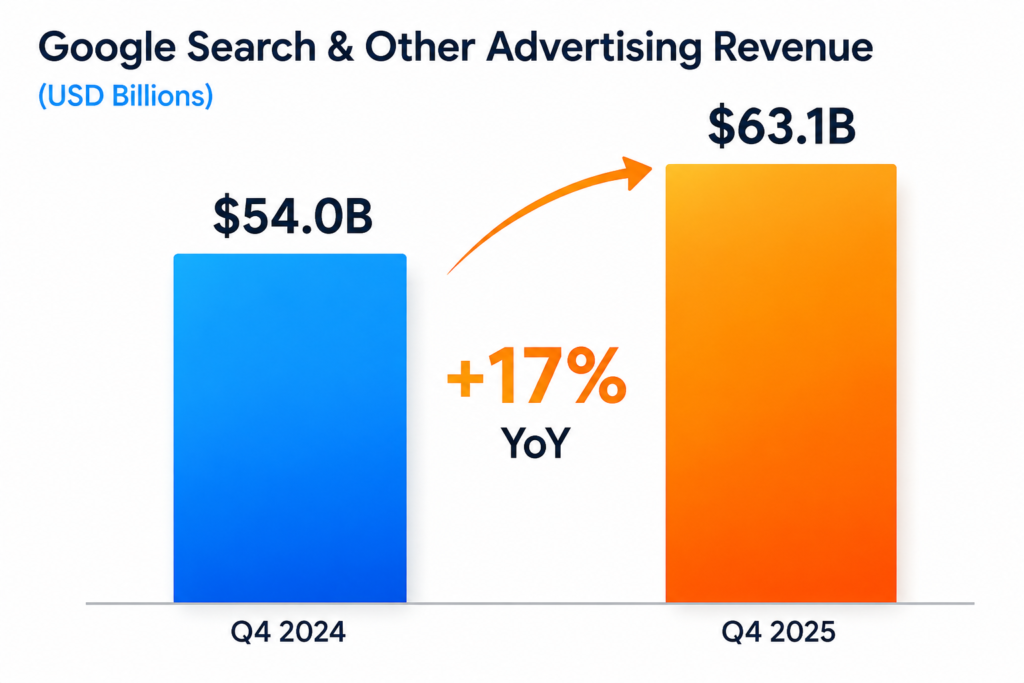
Google Search is not running out of commercial value. Alphabet reported that Google Search and Other advertising revenue reached $63.1 billion in Q4 2025, up 17% year over year. But the search page generating that revenue is being rebuilt around AI.
A customer can now ask a long, specific question, receive a generated comparison, explore follow-up questions and see a sponsored next step inside that experience. Google also reports that 75% of surveyed shoppers who use AI Overviews or AI Mode said AI Mode helped them make faster, more confident decisions. That figure comes from a Google-commissioned Ipsos study, so treat it as directional rather than independent proof.
For your business, the main risk is not that paid search disappears. It is that an account built around rigid keyword lists, shallow conversion tracking and one generic landing page becomes less competitive. This guide explains how Google Ads AI is changing targeting, creative, bidding, measurement and landing-page strategy in 2026.
The practical takeaway
- You cannot buy only an AI Overview placement.
- Existing Search, Shopping and Performance Max campaigns can already be eligible.
- Google evaluates the search query and the AI-generated context, not only a keyword.
- Better business data, landing pages and creative inputs matter more as targeting becomes less manual.
What “Google Ads in AI Overviews” Means in 2026
AI Overviews are generated summaries that appear within traditional Google results. AI Mode is a more conversational search experience that supports follow-up questions. Ads may appear in both, but their availability and format are not identical.
According to Google Ads Help, ads can appear above or below AI Overviews in the 200-plus markets where AI Overviews are available. Ads can also appear inside AI Overviews in English on mobile and desktop in Australia, Canada, India, Indonesia, Kenya, Malaysia, New Zealand, Nigeria, Pakistan, the Philippines, Singapore and the United States.
Current rule | What it means for you |
Eligible campaigns | Existing Search, Shopping and Performance Max campaigns; App and Local ads may appear above or below. |
How matching works | Google considers the user query, commercial intent and the content of the AI Overview. |
Can you target the placement? | No. There is no dedicated AI Overviews ad placement control. |
Can you opt out? | No. |
Can you isolate results in reporting? | Not currently. Ads inside AI Overviews are reported as Top Ads. |
Important restriction | Google currently excludes sensitive verticals such as healthcare, finance, politics, gambling, alcohol and adult content from ads inside AI Overviews. |
This limitation matters. You cannot prove that a change in click-through rate came from AI Overview ads alone. You must diagnose query mix, device, match type, auction pressure, landing-page relevance and conversion quality before blaming a new search layout.
The Old PPC Model Is Too Narrow for Conversational Search
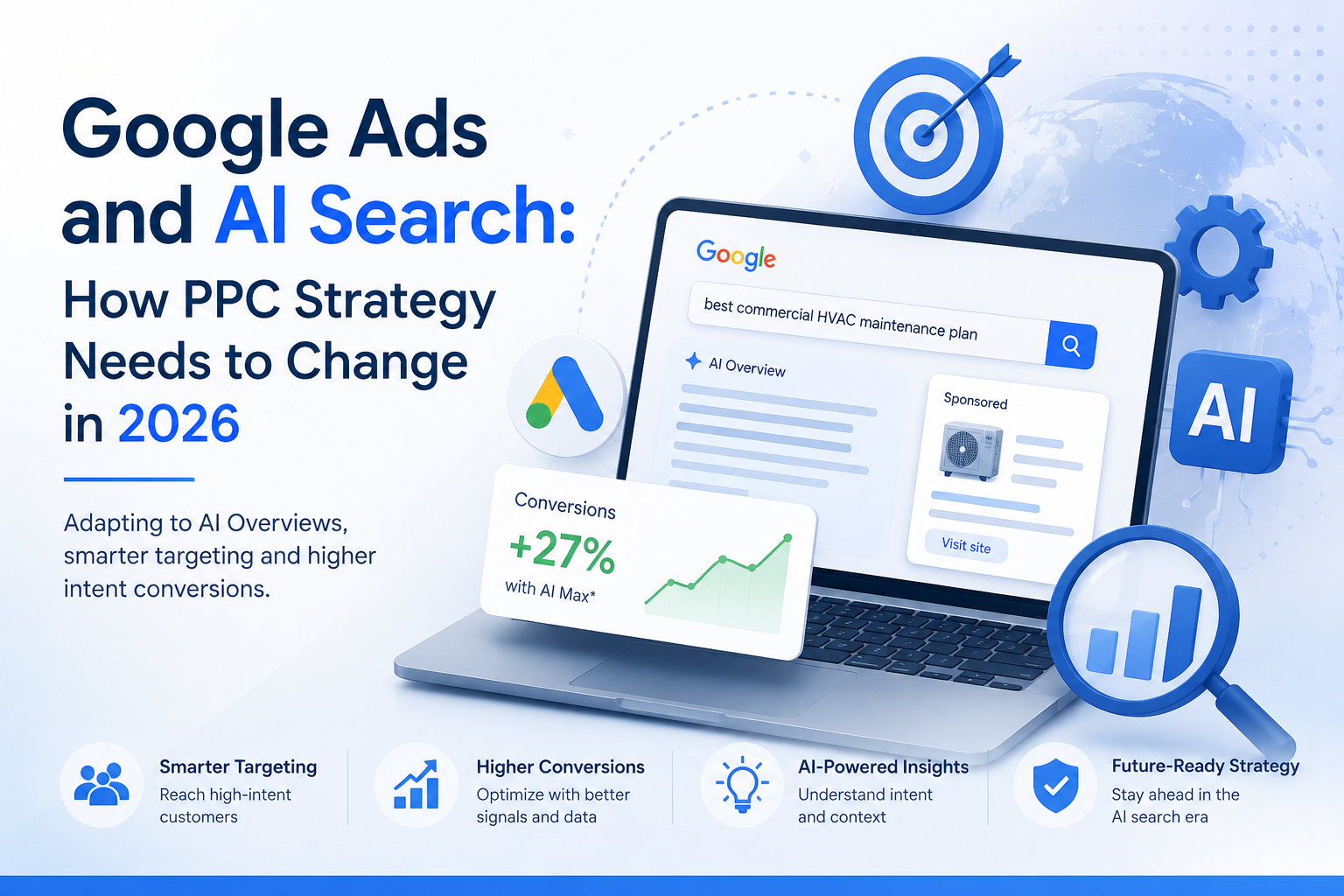
Traditional paid search planning often follows a simple line: keyword, ad, landing page, form submission. AI search adds more context between each step. A query such as “best commercial HVAC maintenance plan for three restaurant locations” contains service need, business type, scale and buying criteria in one sentence.
Google says AI Overview ads may appear even when a query is not overtly transactional. Its own example starts with “why is my pool green and how do I clean it?” The overview explains likely solutions, then a relevant pool-vacuum ad can become the commercial next step.
The implication is direct: your strategy must cover the customer’s problem and decision context, not only the short keyword that a planner tool records.
1. Optimize for Intent Coverage, Not Keyword Volume
Exact and phrase match still have value, especially for brand protection, high-cost terms and controlled testing. But they should no longer be your only discovery system. Google recommends broad match or keywordless targeting through AI Max, Performance Max and Shopping because complex AI searches are less likely to match a manually selected phrase.
Google reported that early AI Max adopters typically generated 14% more conversions or conversion value at a similar CPA or ROAS, rising to 27% for campaigns heavily dependent on exact and phrase match. Those are Google internal results, not a guarantee for your account. Treat AI Max as an experiment, not a switch that automatically improves performance.
- Organize campaigns around commercial problems and service categories, not dozens of microscopic ad groups.
- Keep brand and non-brand demand separated when budget control matters.
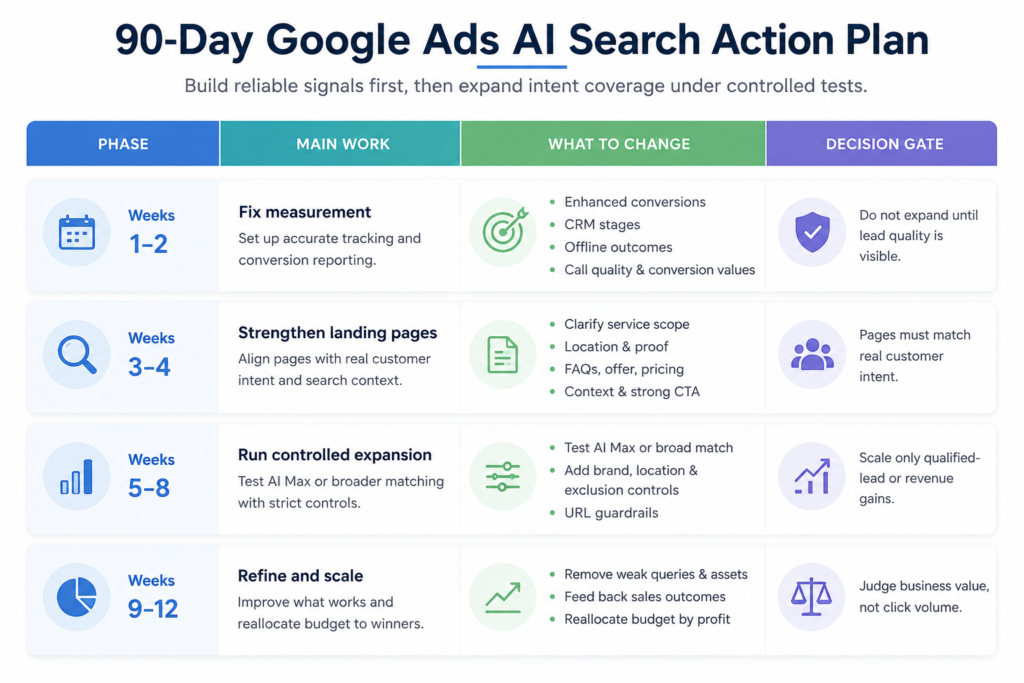
- Use brand, location, negative keyword and URL controls before expanding reach.
- Review the search terms, landing URLs and generated assets, then remove weak patterns quickly.
Business owners working with limited budgets should first establish a stable search foundation. Noah Digital’s Google Ads guide for small businesses explains the basic campaign and budget structure that should exist before broader AI-led expansion.
2. Upgrade Signal Quality Before You Add Automation
Automation does not understand a good customer unless you show it one. When every form submission is recorded as an equal conversion, Google may optimize toward cheap leads that never answer the phone, meet your service criteria or become revenue.
- Use enhanced conversions and reliable first-party measurement.
- Import qualified-lead, sales and revenue outcomes from your CRM.
- Assign different values to a form submission, booked consultation, sales-qualified lead and closed customer.
- Measure phone-call quality, not only call duration or button clicks.
- Exclude internal, duplicate, spam and clearly unqualified conversions from bidding signals.
Google’s journey-aware bidding beta is designed for this direction: Search campaigns can learn from more of the lead-to-sale journey when you track both primary and supporting goals. The technology is new, but the principle is established. Your bidding system needs downstream business outcomes.
What PPC practitioners are reporting
In an r/PPC discussion, one practitioner argued that AI Max can favour cheaper, lower-intent traffic when conversion data does not reflect sales quality. Another post summarizing Google Marketing Live 2026 prioritized enhanced conversions, journey-aware bidding and tighter AI messaging controls. These are practitioner observations, not controlled evidence, but they reinforce the same operational lesson: automation amplifies the quality of your inputs. Read the AI Max discussion and the 2026 action-list discussion.
3. Treat Every Landing Page as a Targeting Asset
AI Max can use your website content to understand relevance, customize ad text and select a landing page through final URL expansion. A vague service page therefore creates two problems: it converts poorly and gives Google weak information about when the page should be used.
- State the exact service, customer type, location and situations you handle.
- Add proof such as certifications, case results, reviews, process details and realistic response times.
- Answer comparison, cost, eligibility and “what happens next” questions.
- Keep pricing, availability, exclusions and promotional claims consistent with your ads.
- Use a specific CTA that matches the search stage, such as “Request an assessment” rather than “Learn more.”
This is where paid media and conversion optimization merge. Noah Digital’s CRO playbook provides additional ideas for reducing friction after the click.
4. Build Creative Systems for Questions, Comparisons and Decisions
More automation does not mean your messaging should become generic. Create reusable message components that Google can combine without changing your commercial position:
- Problem and desired outcome: what the customer needs solved.
- Qualification: location, customer type, minimum project size or eligibility.
- Evidence: experience, result, certification or guarantee you can substantiate.
- Offer: consultation, quote, assessment, trial, delivery or promotion.
- Next step: a clear action and expected response time.
In 2026, Google announced tests for Conversational Discovery ads, Highlighted Answers, AI-powered Shopping ads and a Business Agent for Leads. These formats use Gemini to add explanations or conversational assistance around an advertiser’s information. They are tests or staged launches, not universal features. Do not build a forecast that assumes every account will receive them immediately.
Google is also rolling out AI Brief controls that let advertisers guide messaging, matching and audience emphasis. The strategic change is important: your job is moving from writing every possible ad to defining stronger facts, boundaries and offers that the system can use safely.
5. Change the KPI Hierarchy
AI Overviews ad placement reporting is not segmented, so CTR alone cannot tell you whether the new experience is helping or hurting. A lower CTR may reflect a longer answer above the ad, broader query coverage or weaker traffic. A higher conversion count may still hide poor lead quality.
Review performance in this order:
- Closed revenue, gross profit or qualified pipeline.
- Qualified-lead rate and cost per qualified lead.
- Conversion value, ROAS or customer acquisition cost.
- Conversion rate by query theme and landing page.
- Search terms, generated assets, destination URLs, CPC and CTR.
This hierarchy prevents a common error: celebrating more conversions when Google has simply found more low-quality traffic.
6. Give AI More Budget Flexibility Only After the Economics Are Proven
Google is developing journey-aware bidding, Smart Bidding Exploration and demand-led budget pacing to capture less obvious demand and spend more on peak days. Google reports that Search campaigns using Smart Bidding Exploration averaged 27% more unique converting users, while campaign total budgets reduced manual budget adjustments by 66% in its internal comparisons.
Those gains are useful only when your targets reflect profit and capacity. A home-services company that can handle 30 qualified leads per week should not let automated expansion create 80 low-intent inquiries. Set budget, location and service constraints around operational reality, then scale based on qualified outcomes.
What You Should Not Do in 2026
- Do not assume you can target or exclude Google Ads in AI Overviews directly.
- Do not enable every automated recommendation across every campaign at once.
- Do not use form submissions as the only success signal for lead generation.
- Do not let final URL expansion send paid traffic to weak blogs, outdated pages or irrelevant locations.
- Do not present Google’s tests and beta features as guaranteed inventory.
- Do not blame AI search for a performance drop until tracking, query mix, auctions and landing pages have been checked.