

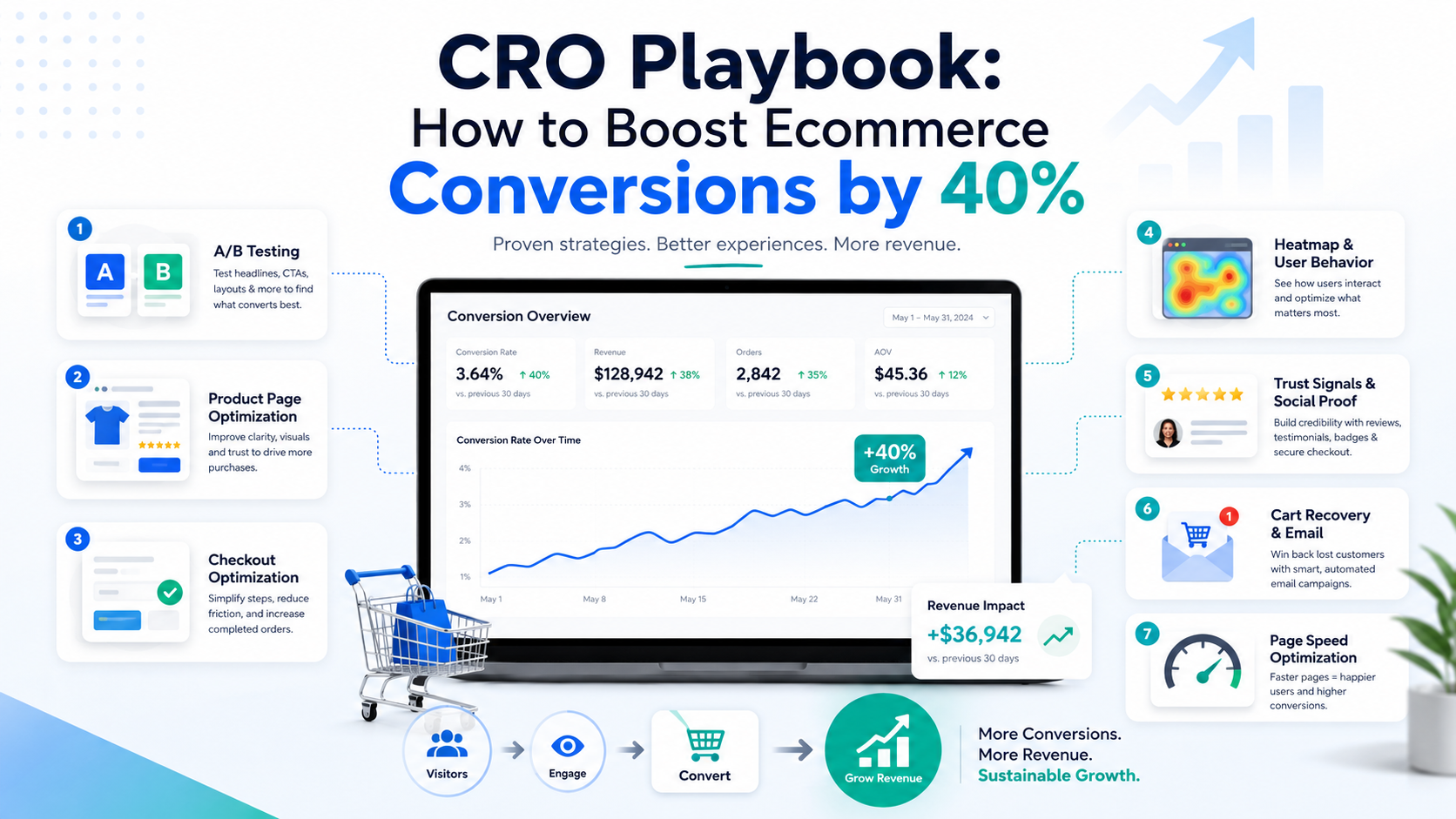
Most ecommerce brands do not need more traffic first. They need to stop losing buyers who already reached the website.
If people visit product pages, add items to cart, start checkout, and still leave, the issue is not only marketing. It is a conversion problem.
That is where ecommerce CRO becomes important. It helps you find where shoppers hesitate, why they leave, and what needs to change so more existing traffic turns into sales.
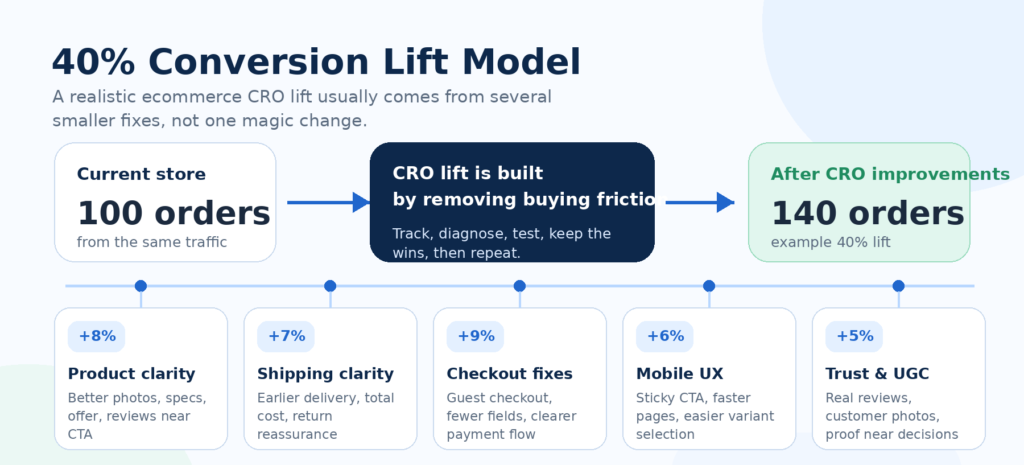
A 40% lift is possible, but it should not be treated as one magic button change. In real ecommerce projects, a strong result usually comes from several smaller improvements working together: better product clarity, clearer shipping, stronger trust signals, faster checkout, and cleaner mobile UX.
Baymard reports that the average cart abandonment rate is 70.19%, and large ecommerce sites may gain up to 35% in conversion rate by improving checkout design alone. That makes checkout one of the most valuable places to inspect when trying to increase ecommerce conversion rate.
First, Fix Tracking
Do not start CRO by changing headlines, buttons, or product images. Start with tracking.
If GA4, Shopify, Google Ads, Meta Ads, or payment data is wrong, your CRO decisions will be wrong too.
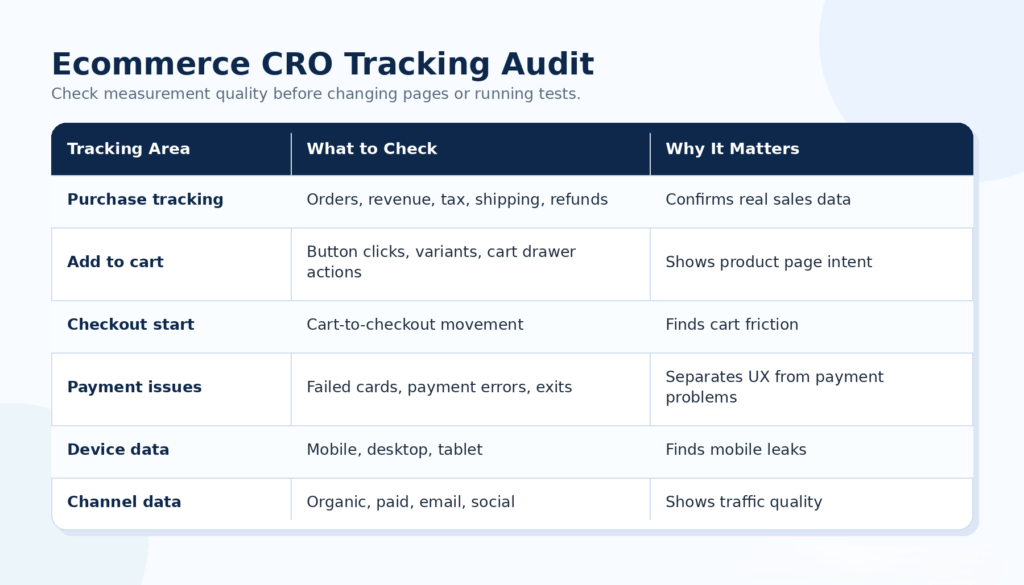
Without clean data, conversion rate optimization ecommerce work becomes guessing.
Find the Biggest Funnel Leak
A low conversion rate does not always mean the whole website is broken. You need to find the exact step where users drop.
Review the funnel in this order:
- Product view to add to cart
- Add to cart to cart view
- Cart view to checkout start
- Checkout start to purchase
- Purchase to repeat purchase
Each drop-off means something different.
If product views are high but add-to-cart is low, the product page may lack trust, clear photos, pricing context, sizing details, or delivery information.
If add-to-cart is strong but purchases are low, the issue is usually closer to checkout: shipping cost, delivery time, payment options, account creation, or weak trust.
Reddit ecommerce discussions show this clearly. One Shopify store owner shared a case with a high add-to-cart rate but only 0.83% conversion rate, which points to lower-funnel friction rather than a pure traffic issue. Another Reddit user described strong add-to-cart and checkout activity but weak purchase volume, asking what could build more trust and urgency.
Improve Product Page Clarity
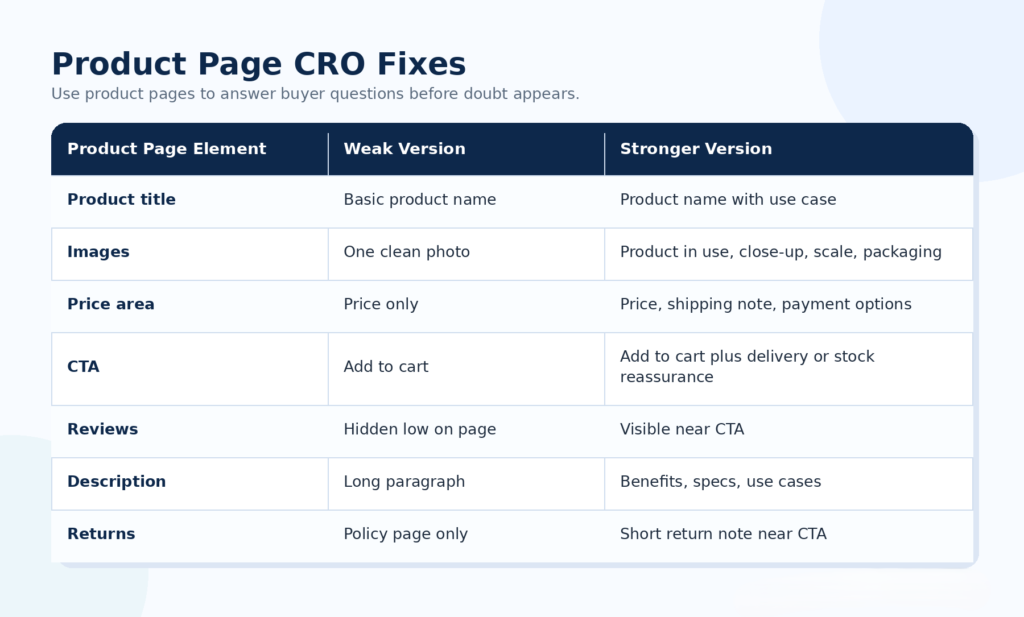
A product page should answer buyer questions before doubt appears.
A strong product page explains:
- What the product is
- Who it is for
- What makes it different
- What is included
- How sizing, fit, material, or compatibility works
- When it will arrive
- How returns work
- Why the store can be trusted
Most ecommerce CRO wins come from clarity, not decoration.
On mobile, do not bury important details far down the page. Many shoppers will never reach them.
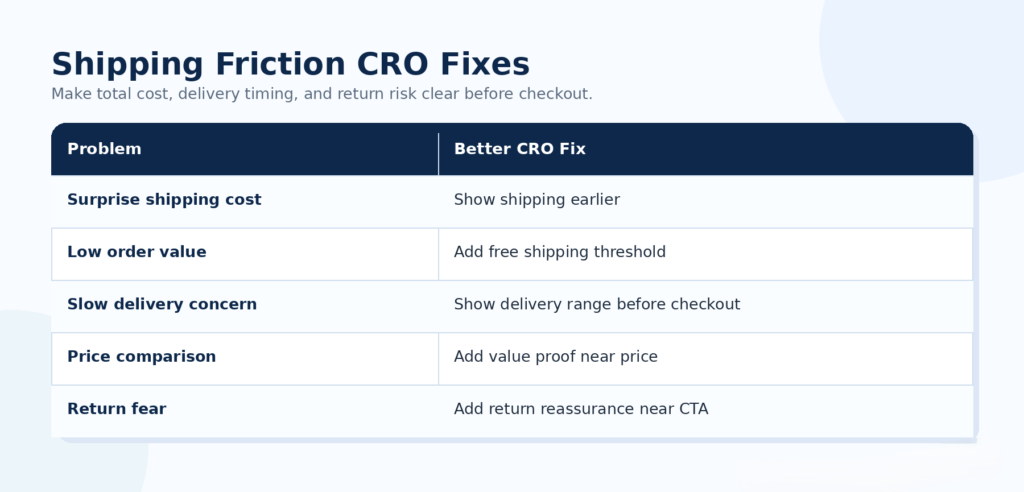
Treat Shipping as a Conversion Factor
Shipping is not just an operations detail. It directly affects sales.
Baymard’s abandonment data shows the top checkout abandonment reason is extra costs being too high, including shipping, tax, and fees. Other major reasons include slow delivery, lack of payment trust, forced account creation, long checkout, weak return policy, and hidden total cost.
Reddit users say the same thing in simpler words. In one Shopify discussion, a commenter advised checking shipping and pricing because shoppers may add items to cart, then leave to compare the final cost.
You do not always need free shipping. You need clear shipping.
Reduce Checkout Friction
Checkout is where buying intent is highest, so small problems become expensive.
Baymard reports that 19% of shoppers abandon because they do not trust the site with card information, 19% leave because the site requires account creation, 18% leave because checkout is too long or complicated, and 10% leave because there are not enough payment methods.
Fix these first:
- Allow guest checkout.
- Show total cost before the final step.
- Remove unnecessary fields.
- Add trusted payment methods.
- Make errors clear.
- Keep delivery and return details close to the order summary.
- Do not make coupon fields more visually dominant than checkout completion.
A checkout test should measure checkout completion rate, not only total site conversion rate.
Segment CRO by Traffic Source
Not all visitors behave the same.
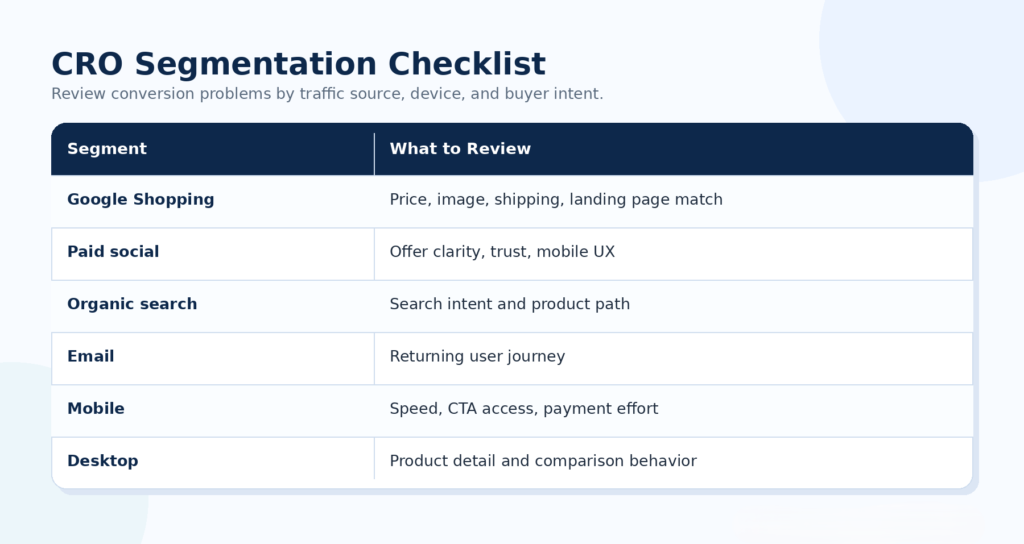
A Google Shopping visitor may compare price and delivery. A paid social visitor may need more trust. An organic search visitor may need stronger intent matching. An email visitor may already know the brand and need a faster path to checkout.
Dynamic Yield benchmark data shows ecommerce conversion rates differ by region and device, with the Americas at 2.88%, EMEA at 2.65%, and APAC at 1.7%. It also reports different conversion rates for tablet, mobile, and desktop.
Segment CRO analysis by:
Test With a Clear Hypothesis
Random testing wastes time.
Use this format:
Because we saw [data problem], we believe [friction cause].
If we change [specific element], then [specific metric] should improve.
We will measure [main metric] and monitor [risk metric].
Example:
Because mobile users reach the product page but do not add to cart, and heatmaps show they scroll to shipping details, we believe delivery uncertainty is slowing decisions. If we add delivery estimates near the CTA, mobile add-to-cart rate should improve. We will measure add-to-cart rate and monitor checkout completion and refund rate.
A Reddit ecommerce user gave similar practical advice: use A/B testing, heatmaps, and customer feedback, but avoid overloading the site with too many popups, upsells, and discount messages that can make the store feel spammy.
Final Thoughts
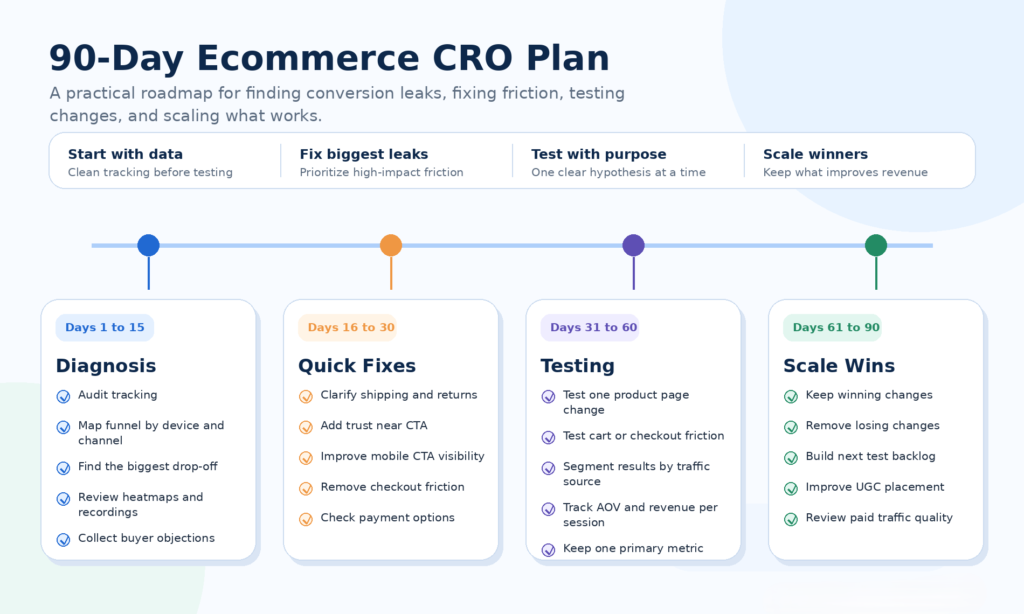
To increase ecommerce conversion rate, do not start by guessing what looks better. Start by finding where buyers stop.
The strongest ecommerce CRO plan is built on clean data, clear product pages, transparent shipping, fast checkout, mobile usability, and proof from real customers.
A 40% lift is not one trick. It is the result of fixing several points of friction across the buying journey. For ecommerce brands, conversion rate optimization ecommerce work should be treated as a revenue system, not a design task.