



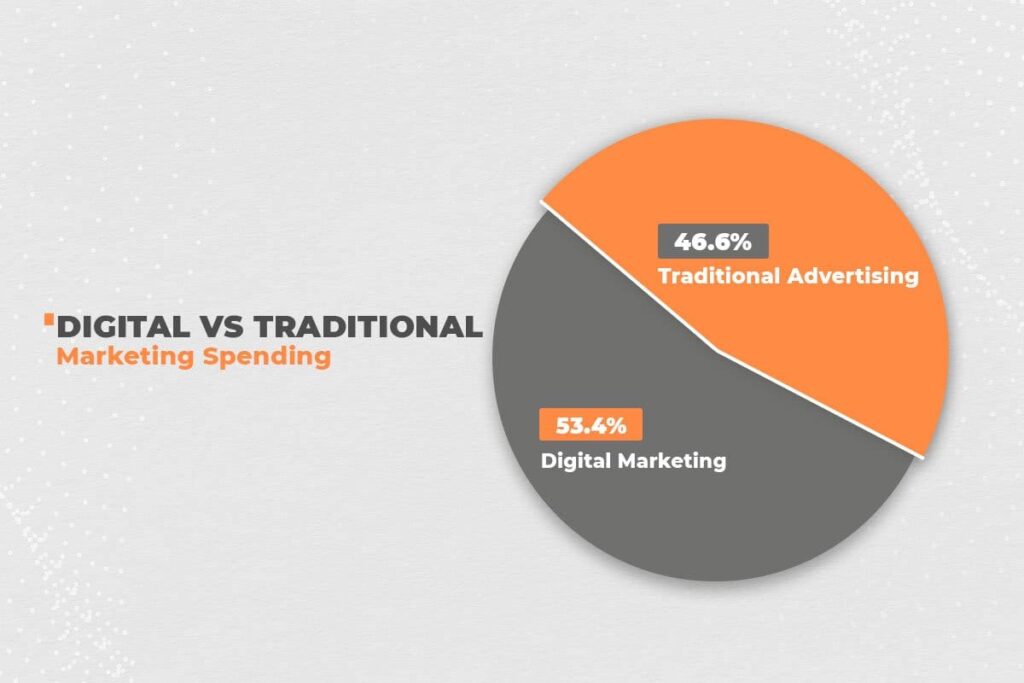
When examining the average marketing budget by industry, it becomes evident that marketing investments vary significantly depending on the sector. As digital platforms increasingly dominate, industries shift their budgets to online strategies. In 2024, businesses, on average, allocate 53.4% of their marketing spend to digital channels, while the remaining 46.6% support traditional avenues like print, TV, and radio.
Let’s examine the typical marketing expenditures across a few popular industries and explore statistics from some of the top-performing businesses within them.
Average Marketing Budget by Industry
The average marketing budget by industry is influenced by various factors such as business goals, target audiences, and the competitive landscape of the sector. Different industries allocate their marketing spending differently, with some, like retail and eCommerce, leaning heavily toward digital channels, while others, such as healthcare and pharmaceuticals, may still invest significantly in traditional advertising methods. The breakdown of budgets often reflects the specific needs and customer behaviours of each industry, highlighting the importance of strategic investment in both digital and traditional media to achieve marketing success.
Source:upflip
Here’s a breakdown by industry:
- Educational companies allocate 75.5% of their marketing budget to digital channels.
- Technology firms direct 65.7% of their marketing budget towards digital marketing.
- Healthcare organizations invest 64.6% of their budget in digital marketing efforts.
- Banking, finance, and insurance companies, however, dedicate 60.7% of their marketing budget to traditional marketing.
- Real estate companies allocate 60% of their marketing spend to traditional channels, while manufacturers devote 56% of their marketing budget to traditional methods.
Recommendation Based on Research: Businesses should allocate between 39.3% and 75.5% of their marketing budgets to digital marketing and between 24.5% and 60.7% to traditional marketing, depending on their industry.
Where the Majority of Companies Set the Limit 4
A recent survey of 1,800 participants sheds light on the average marketing budget for small businesses. It reveals that 66.3% of small business owners allocate less than $1,000 annually toward marketing efforts. A smaller group, around 19%, spends between $1,000 and $10,000 each year. Meanwhile, 15% of small businesses are willing to invest over $10,000 annually to support their marketing strategies. This range of spending highlights the differences in how small businesses prioritize their average marketing budget by industry depending on their goals and available resources.
Social Media Marketing
Social media marketing combines organic and paid strategies to connect with customers on platforms like Facebook, Instagram, and TikTok.
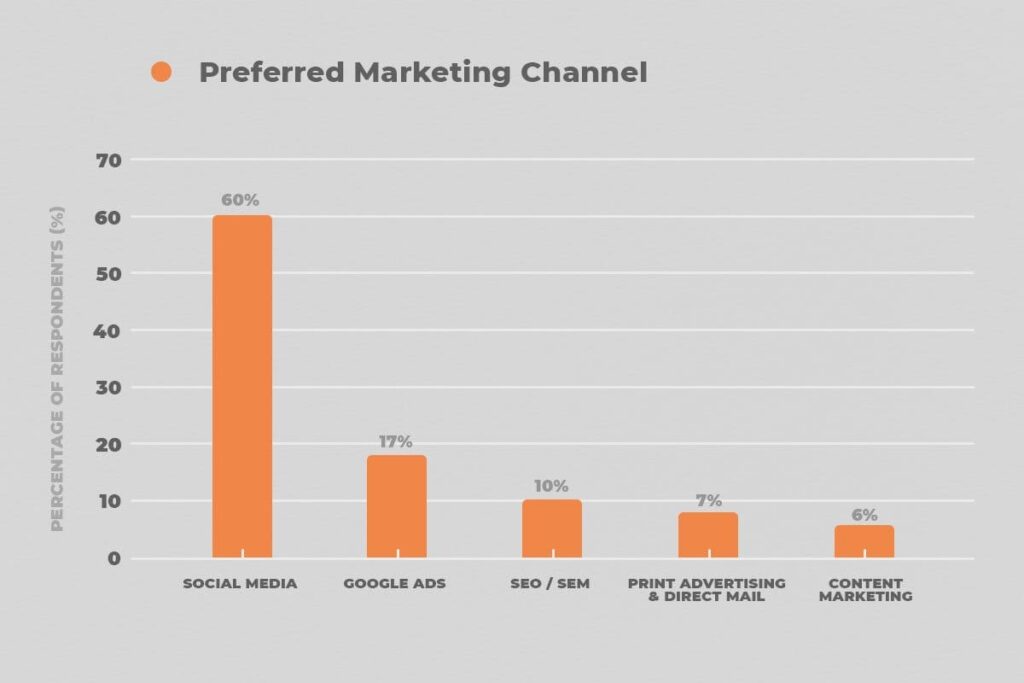
60% of small business owners prefer social media marketing over methods such as Google Ads, Search Engine Optimization -SEO/SEM, print advertising, and content marketing.
Source:upflip
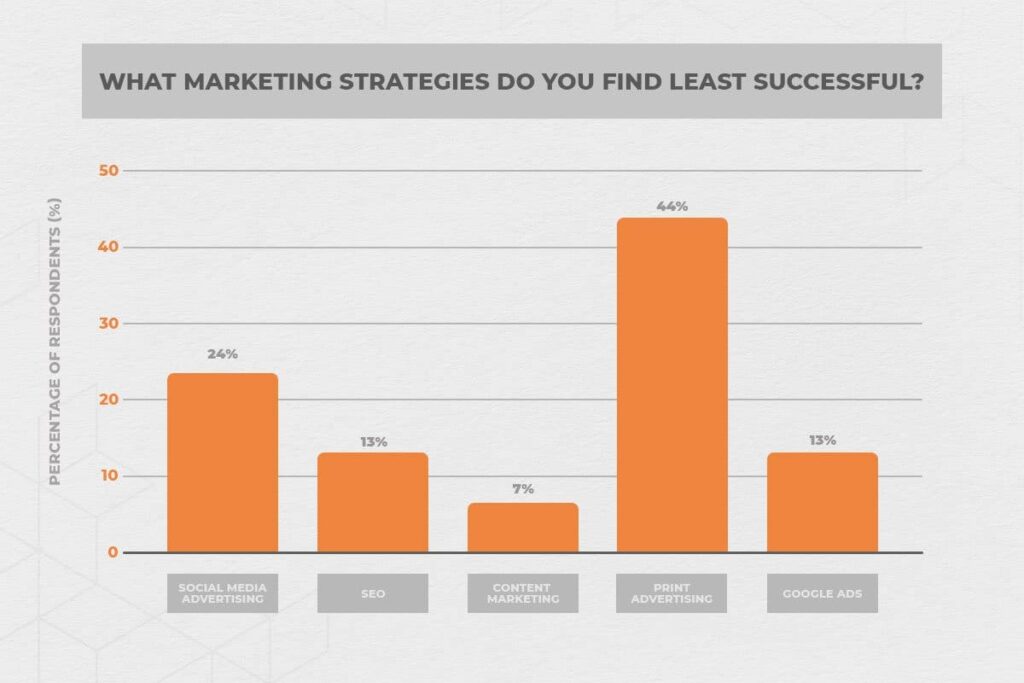
However, while it dominates in terms of preference, 24% of small business owners report it as their least successful strategy. The average budget for social media marketing can vary, but many small businesses still prioritize it despite mixed results.
Source:upflip
The Effectiveness of Content Marketing
Content marketing focuses on producing and sharing blogs, videos, and other valuable content to raise awareness about products and services. This approach is often highly effective, as it builds authority with both potential customers and search engines.
Although only 6% of businesses currently use content marketing, just 7% reported it as an unsuccessful strategy. These figures suggest that small business owners could see significant benefits by dedicating more resources to content creation. Considering the average marketing budget by industry, companies may want to allocate a portion toward content marketing to enhance overall results.
Preferred Ad Platforms
Business owners have a variety of paid advertising platforms to choose from, but some deliver stronger results than others.
44% of small business owners favour Google Ads over alternatives like Instagram/Facebook ads (32%), YouTube ads (13%), and TikTok ads (11%). Additionally, 17% of small business owners prefer Google Ads over other marketing methods, with only 13% expressing dissatisfaction with its performance. Given the average marketing budget by industry, many companies find Google Ads to be a valuable investment compared to other advertising platforms. When evaluating performance, comparing your campaign metrics against Google Ads Industry Benchmarks can help determine if your results are truly competitive for your sector.
Specific Marketing Campaign Costs
Small business owners should allocate their marketing budgets by campaign to understand the actual costs associated with various marketing tactics and tools.
- Content Marketing Budget: Plan to spend at least $29 per piece, although top content creators may charge up to $1,000 per piece. Some may also charge between $0.05 and $1 per word.
- Paid Digital Advertising Budget: Small businesses can expect to pay around $2.59 per click, $3.12 per 1,000 impressions, and $0.66 to $1.23 for remarketing. Additionally, budget $15 to $800 for tools and a minimum of $350 per month for paid digital advertising.
- Monitor Ad Budget: If hiring someone to oversee ads, expect to allocate between $350 and $5,000 per month, or 12% to 30% of the monthly ad spend, whichever amount is greater.
- Email Marketing Budget: This will vary based on the number of email addresses on your list and the features you need. Generally, expect to spend around $18 per month for up to 1,000 contacts. As your list grows, costs may rise to $540 per month, in addition to any labour expenses.
- Social Media Marketing Budget: For 2023, social media marketing was projected to reach $72.33 billion, averaging about $2,178.62 per business.
- Sales Funnel Automation Budget: Costs here will vary based on the number of automations used in your email marketing, social media marketing, and other strategies.
- Marketing Tools and Software: Depending on your company size and customer base, your budget for tools can range from free options to several thousand dollars monthly. These may be categorized separately or included in other marketing expenses.
- Traditional Advertising Budget: According to The CMO Survey, traditional marketing budgets are expected to decline by 2.6%. This category includes print ads, outdoor advertising, radio, and similar channels.
Understanding these specifics will help small business owners better determine their average budget for marketing campaigns.
Online vs. Traditional Businesses
Online businesses are 75% more likely to boost their marketing budgets.
This year, 70.6% of online businesses are either raising their marketing budgets or maintaining them at the same level. Among businesses generating less than 10% of their revenue from online sales, 40% have stable or increasing marketing expenditures, while 60% are reducing their marketing budgets.
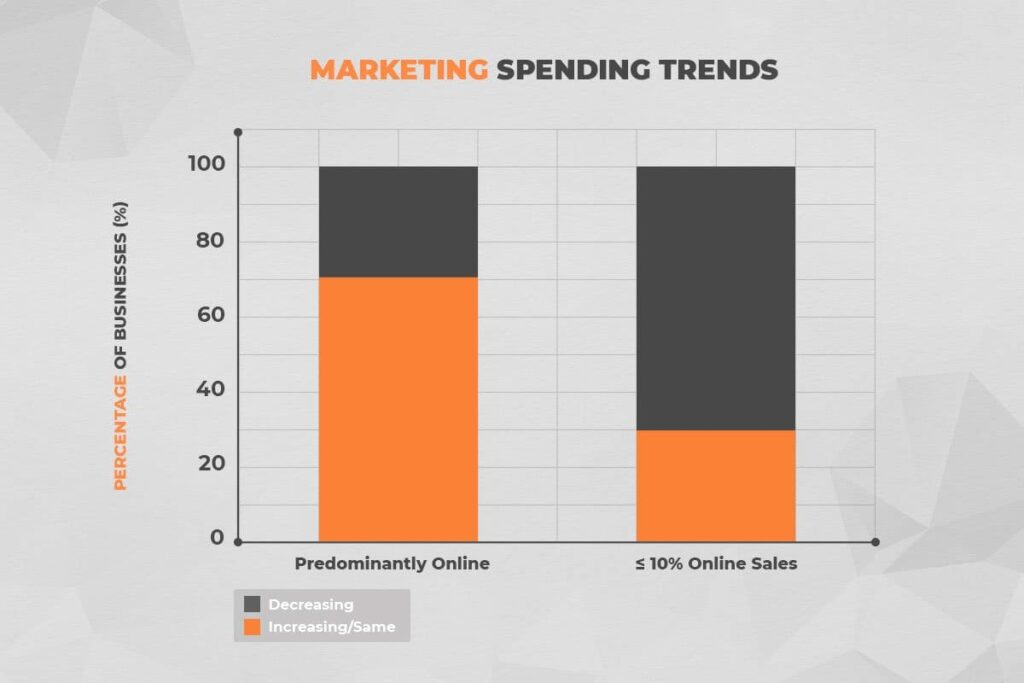
These findings align with consumer trends, showing that online sales are growing their overall share by about 1% annually.
Conclusion
In conclusion, understanding the average marketing budget by industry is essential for businesses aiming to allocate their resources effectively. With digital marketing rapidly gaining prominence over traditional channels, businesses across sectors are adjusting their strategies to stay competitive. These small business marketing budget statistics serve as a valuable guide, especially for companies transitioning to a more digital-focused approach. As online marketing continues to grow and traditional advertising sees a gradual decline, small business owners must adapt by increasing their investments in digital strategies such as social media, content marketing, and paid digital advertising. By leveraging these insights, companies can ensure they are setting realistic and effective marketing budgets that align with their industry and growth goals.