

A content marketing funnel is a powerful tool for any business aiming to attract and retain customers. It guides potential customers through different stages—from gaining awareness of your brand to making a purchase and beyond. If you’re a business owner, having a well-defined content marketing funnel can help you create targeted messages that speak directly to the needs of your audience at each stage of their buying journey.
However, without a content marketing funnel, you may face several challenges. You might struggle to convert website visitors into customers because they’re not receiving the right information at the right time. This can lead to missed sales opportunities and inefficient marketing efforts, as you’re not nurturing your leads effectively throughout their decision-making process. Therefore, integrating a content marketing funnel is crucial for streamlining your marketing strategy and boosting your business’s growth.
Table of contents
Why the Content Marketing Funnel is Crucial for Business Success
The content marketing funnel is an essential strategy for driving success in digital marketing. It helps guide potential customers through their journey, from awareness of your brand to becoming paying customers. At each stage of the funnel, you can strategically tailor your content to address the unique needs of your audience, which ultimately maximizes conversions and increases ROI.
Without this funnel, businesses may struggle to convert visitors into customers, missing key sales opportunities. Additionally, a well-structured content marketing funnel can help businesses get rid of spam leads, ensuring higher quality prospects and better conversion rates. By ensuring that each piece of content aligns with the customer’s current stage, whether it’s generating awareness, building trust, or prompting a decision, you can create a seamless and efficient experience that drives growth.
Moreover, integrating SEO with your content marketing funnel not only helps guide users through the journey but also enhances visibility. At each funnel stage, optimized content ensures your business ranks well in search engines, attracting more organic traffic and targeting users who are actively looking for solutions to their problems. By leveraging both content and SEO, businesses can build stronger relationships with customers, eliminate irrelevant leads, and ensure better conversion rates across all funnel stages.
A well-structured content marketing funnel doesn’t just convert visitors into customers, it also harnesses the power of content marketing for customer retention by continually offering value. By delivering the right message at the right time, businesses can nurture long-term relationships, ensuring sustained customer loyalty and repeat business.
What is a Content Marketing Funnel
A content marketing funnel helps marketers see how to use their existing content to attract potential customers and guide them through their journey until they reach a goal, like making a sale, signing up for a demo, downloading something, or another type of conversion. For instance, integrating a digital marketing strategy for the global market can be crucial in reaching a broader audience.

Each stage of the funnel has a specific purpose, such as getting attention, generating good leads, and closing deals. Search engine optimization (SEO) and PPC management services can be pivotal in these stages.
This funnel helps brands see where they might be missing content along the customer journey. Performing different types of content gap analysis helps identify where your existing content falls short and what additional content is needed to guide customers effectively through the funnel.
For instance, if a brand has a lot of content for people who are just becoming aware of their products but not enough for those ready to make a decision, they should focus on creating more content for the decision stage.
So, what is a content marketing funnel? It’s a plan to engage and convert potential customers through relevant content.
What are the Levels of the Content Marketing Funnel?
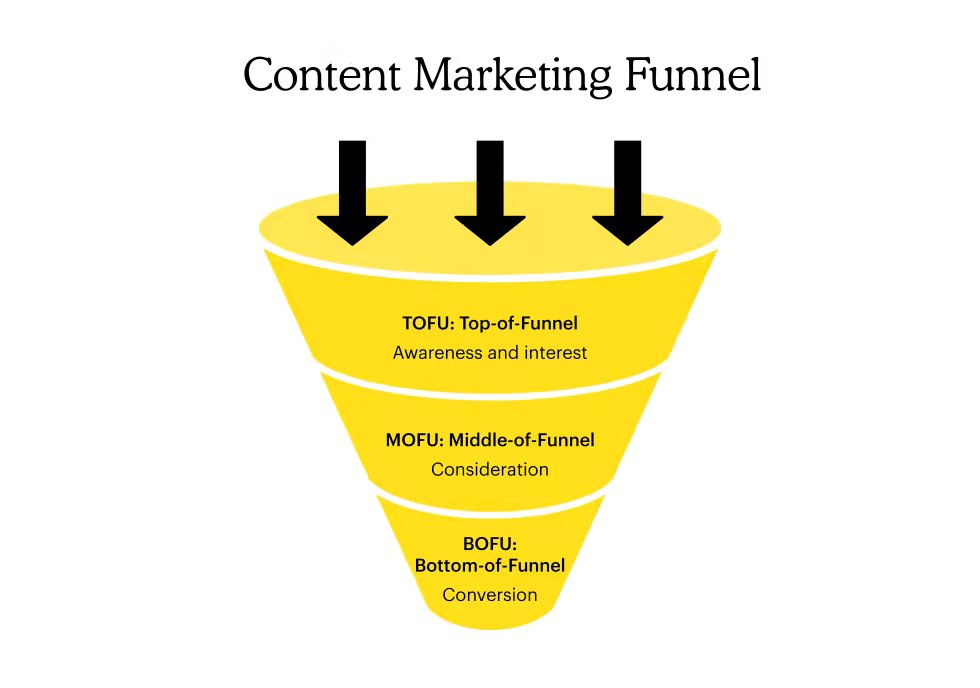
Generally, the content marketing funnel has three stages. The first stage, known as the top of the funnel or TOFU, is where people first learn about the brand. The second stage called the middle of the funnel or MOFU, is when potential customers interact with your company and think about why they should choose you. The last stage, known as the bottom of the funnel or BOFU, is when the decision-making process ends, and the aim is to close a sale.
Top of the Funnel (TOFU)
The top-of-funnel is the starting point where you create content to attract potential customers. Here, you introduce your brand to a broad audience, aiming to maximize brand awareness. This is your opportunity to make a great first impression. Focus on producing content that is captivating, and appealing, and encourages people to discover more about what you provide. Utilizing digital marketing trends can help keep your content fresh and relevant.
Content ideas for ToFu:
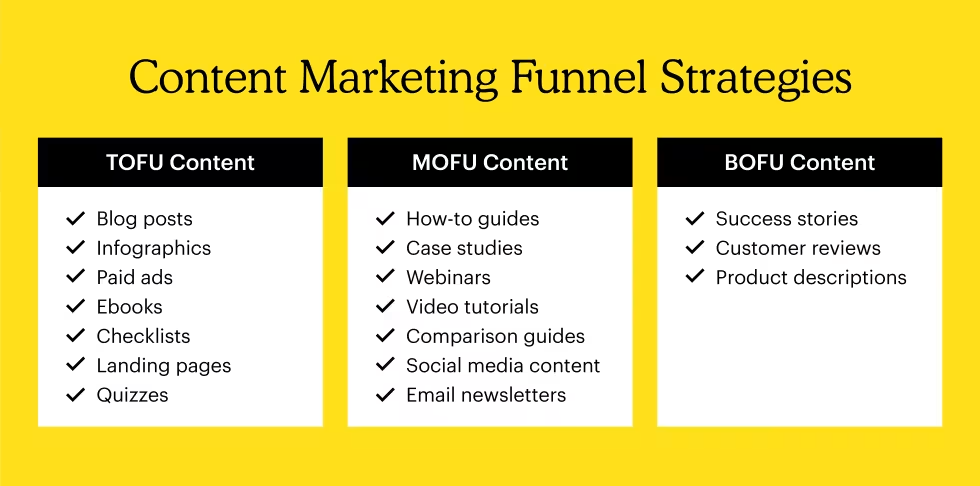
- Blog posts answering common industry questions (e.g., “How to Improve Sleep Quality?”)
- Infographics explaining complex concepts in a simple way
- Social media posts sharing valuable tips or insights
The goal here is to attract the broadest audience possible while building trust and credibility.
Middle of the Funnel (MOFU)
The middle-of-the-funnel stage is when potential customers are thinking about choosing your brand and want to know more about your business. They might be looking at success stories from other customers, checking your social media, or reading guides that compare what you offer to other options. At this point, your aim is to teach them about what you offer so they feel confident in choosing to work with your company. Incorporating a digital marketing strategy for your business can be particularly effective here.
Content ideas for MoFu:
- Case studies that show how your solution helped others
- Comparison guides that explain the benefits of your product over competitors
- Webinars or downloadable resources (eBooks, whitepapers)
This content should provide more in-depth knowledge to educate your audience and nurture leads.
Bottom of the Funnel (BOFU)
The bottom-of-the-funnel level is the final step where customers decide to buy. Here, you help customers who are ready to choose but aren’t sure what to do next. Your aim is to turn these ready buyers into paying customers. Remember, some customers might quickly go through the buying process in a few minutes, while others might take weeks to decide. Your job is to figure out where each customer is in their buying journey and give them specific content to guide them.
Content ideas for BoFu:
- Product demos or free trials
- Customer testimonials and reviews
- Limited-time offers or discounts
The goal is to convince the customer that your solution is the right one and prompt them to make a decision.
Source: mailchimp
Evaluating the Impact of Content Marketing
To really understand how valuable your marketing funnel is, you need to know how content marketing works at each stage. Here’s how you can check how well your content is doing throughout the funnel:
- Track Key Performance Indicators (KPIs): Find and follow the right KPIs for each part of the funnel to see how your content is doing. Look at things like how many people visit your website, how engaged they are, how many leads turn into customers, and how many customers keep coming back. These numbers tell you if your content strategy is working.
- Use Attribution Modeling: Use attribution modelling to figure out which parts of your content are helping make sales or conversions. Models like first-touch, last-touch, or multi-touch attribution help you see which content pieces are most important in making sales and earning money.
- Do Content Audits: Check your content regularly to make sure it’s still relevant, high-quality, and effective. Find content that your audience likes and use it more across the funnel. If some content isn’t doing well, update it or stop using it to keep your content strategy strong. Consider using a digital marketing audit for global markets to ensure a comprehensive review.
- Use Marketing Analytics Tools: Use marketing analytics tools to get useful information about how your content is performing. Tools like Google Analytics, HubSpot, and SEMrush offer strong analytics that help you track, study, and improve your content marketing efforts.
Maximizing the Value of Your Marketing Funnel
Equipped with a deep understanding of your marketing funnel’s value, it’s time to refine your content marketing approach for optimal results. Here are practical steps to boost your content efforts:
- Customize Content Experiences: Shape your content to meet the specific needs, preferences, and challenges of your audience at different stages of the funnel. Customizing content boosts engagement, builds trust, and improves conversion rates. Implementing a Facebook ad strategy can be highly effective in this customization.
- Diversify Content Types: Experiment with various content forms like videos, podcasts, infographics, and interactive quizzes to suit different learning styles and preferences. Testing different types allows you to discover the most effective methods for engaging your audience and enhancing conversions.

- Implement Automation and AI: Utilize automation and AI tools to simplify the processes of content creation, distribution, and analysis. Tools like automated workflows, chatbots, and predictive analytics help provide timely, relevant content experiences and improve campaign efficiency.
- Enhance Cross-Channel Integration: Eliminate barriers between different marketing channels and ensure cohesive integration across all platforms and touchpoints. An integrated omnichannel approach ensures consistent messaging and experiences, boosting brand recognition and customer loyalty.
Metrics to Track for Each Funnel Stage
Each stage of the content marketing funnel requires different metrics to measure success. These metrics help businesses evaluate how well their content is performing and guide improvements.
Top of the Funnel (ToFu) Metrics
ToFu is all about creating awareness and attracting a large number of potential customers. At this stage, the focus is on driving traffic and engaging people with valuable content. The metrics you track here will help you evaluate how well you’re capturing the attention of your target audience.
- Website Traffic: Measures how many people visit your website. More visitors mean your content is effective in attracting attention.
- Bounce Rate: Indicates how many visitors leave without interacting. A high bounce rate suggests content isn’t engaging enough.
- Time on Site: Tracks how long users stay on your site. The longer the better, as it indicates interest.
- Social Media Shares: Measures how often your content is shared, extending your reach.
- Leads Generated: Refers to the number of sign-ups or form submissions, showing engagement with your content.
Middle of the Funnel (MoFu) Metrics
At MoFu, prospects are actively considering their options. Your content should now focus on building relationships and positioning your brand as the best solution. These metrics help you evaluate how well you’re nurturing leads and guiding them toward a purchase decision.
- Lead Conversion Rate: Measures how many website visitors convert to leads. Higher rates indicate your content is resonating.
- Downloads: Tracks how many people download resources like eBooks or whitepapers, indicating interest in your offering.
- Email Open and Click-Through Rates: Measures engagement with email content, signaling how well your messaging connects.
- Webinar/Case Study Engagement: Tracks participation in deeper, informative content, showing interest in your solution.
Bottom of the Funnel (BoFu) Metrics
At the BoFu stage, prospects are ready to make a purchasing decision. The focus is on motivating them to take that final step, whether it’s signing up for a service, completing a purchase, or contacting your sales team. The metrics at this stage are key indicators of conversion success.
- Sales Conversions: The most important metric, showing how many leads convert to customers.
- ROI: Measures the return on investment from your content marketing efforts. A higher ROI means better profitability.
- Customer Acquisition Cost (CAC): Calculates how much you spend to acquire a new customer. A lower CAC indicates efficient marketing.
- Average Deal Size: Tracks the average value of each sale, helping gauge the success of higher-value offers.
- Customer Lifetime Value (CLV): Measures how much revenue a customer will bring over time. Increasing CLV boosts long-term business profitability.
How to Use These Metrics
Tracking the above metrics will provide you with a holistic view of how well your content is performing at each stage of the funnel. Here’s how you can use these metrics to improve your content marketing funnel:
- Identify Gaps in Content: If certain stages of your funnel aren’t performing well, it may indicate a gap in your content. For example, if your ToFu traffic is high but your MoFu conversions are low, it suggests that you may not be providing enough value to leads or nurturing them effectively.
- Refine Your Content Strategy: Use your metrics to determine which types of content are most effective at each stage. For example, if webinars are driving significant engagement at MoFu, consider increasing the frequency of these events.
- Optimize for Better Conversions: For BoFu, focusing on converting leads into customers is crucial. Use A/B testing to optimize your product pages, calls-to-action (CTAs), and offers. If a particular CTA drives more sales, implement it across other parts of your funnel.
- Make Data-Driven Adjustments: Regularly monitor these metrics and make adjustments as necessary. If you notice a drop in engagement or conversions, it’s a sign that your content or strategy needs fine-tuning.
Conclusion
In conclusion, a content marketing funnel is essential for guiding potential customers through their buying journey, from first learning about your brand to making a purchase. By creating targeted content for each stage of the funnel—awareness, consideration, and decision—you can ensure that your marketing efforts are efficient and effective. Without a well-defined funnel, you risk losing potential customers due to a lack of timely and relevant information. Therefore, integrating a content marketing funnel into your strategy is crucial for nurturing leads and boosting sales. For more information or assistance, feel free to contact us.
FAQs
A marketing funnel comes before a sales funnel. The marketing funnel’s job is to attract people to the brand and introduce them to it. The sales funnel’s job is to take these people, who may not know much or only a little about the brand, and lead them to make a purchase.
The Top of the Funnel Problem: An Overlooked Opportunity
People who are just starting to learn about a problem are not ready to buy yet, so many companies don’t focus on them.
Common problems with sales funnels include not having a clear funnel, not getting enough leads at the top, and having poor-quality leads. These can be fixed by aligning the funnel with business goals, increasing visibility and lead generation, and targeting the right audience.