

Running PPC ads in one language is simple. Running PPC ads in the language your customers actually use is where the growth opportunity starts.
Multilingual PPC advertising helps businesses reach buyers who search, compare, and make decisions in different languages. This matters because the internet is no longer an English-first channel in practice. DataReportal’s global internet language usage statistics show that more than 6 billion people are now online, and that growth is coming from markets where English is not always the main buying language.
That does not mean every business should immediately launch ads in ten languages. That would be careless. The real value comes from using multilingual Google Ads campaigns where there is clear demand, localized landing pages, and enough budget to measure performance properly.
What Is Multilingual PPC Advertising?
Multilingual PPC advertising means creating paid search, display, shopping, or social ad campaigns for audiences who speak different languages. It usually includes translated or localized ad copy, language-specific keywords, separate landing pages, localized CTAs, and campaign settings built around each target audience.
This is different from simply translating one English campaign into another language. A strong international PPC strategy considers how people actually search in each market.
For example, a Canadian company targeting English and French speakers should not only translate “PPC agency” into French. It should check whether users search for “agence PPC,” “agence Google Ads,” “publicité Google,” or a more local phrase. The same logic applies to Spanish, German, Arabic, Mandarin, Portuguese, or any other target language.
This is why multilingual keyword research is not optional. It is the foundation of PPC for multilingual audiences.
Why Multilingual PPC Advertising Matters
The main benefit is simple: people trust what they understand.
CSA Research found that 76% of online shoppers prefer products with information in their own language, while 40% will not buy from websites in other languages. That is not a small UX issue. It directly affects conversion potential.
Multilingual marketing also helps businesses avoid a common mistake: assuming that English search behaviour represents global demand. It often does not.
A user in Germany may search differently from a user in Switzerland. A Spanish speaker in Mexico may use different terms from a Spanish speaker in Spain. A French speaker in Quebec may not respond to the same wording as a French speaker in France.
Good international PPC respects those differences instead of flattening them.
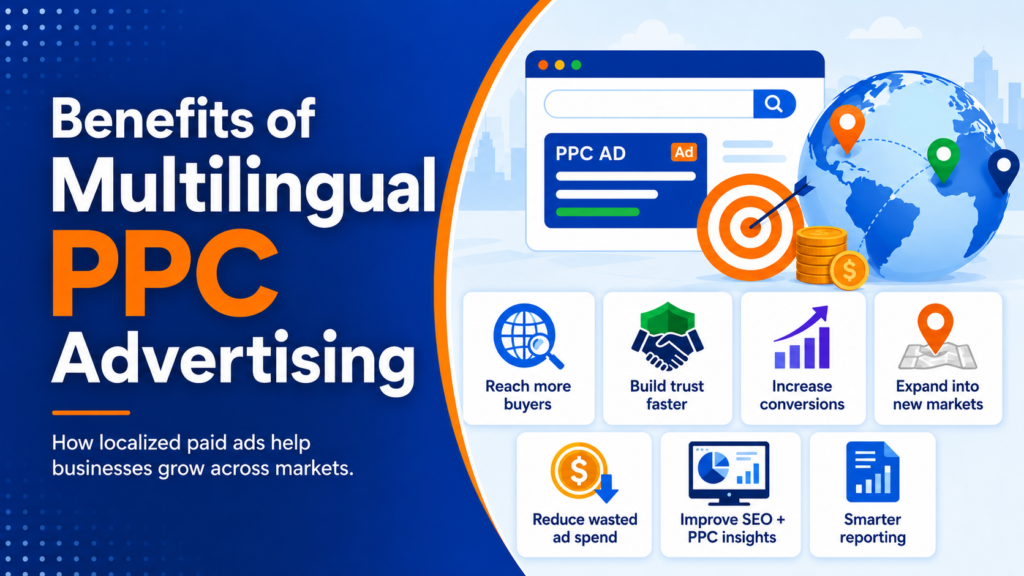
1. You Reach More High-Intent Buyers
The first benefit of multilingual PPC advertising is expanded search coverage.
If your ads only target English keywords, you miss users searching in their preferred language. These users may already know what they want. They may be comparing providers, checking prices, or looking for a local solution. But your campaign will not reach them if your keyword set is locked into one language.
This is where multilingual keyword research becomes valuable. Google Keyword Planner can help identify keyword variations, search volume, and competition by location, but the work should not stop there. You also need native-language review, competitor checks, and search term analysis after launch.
A weak multilingual campaign translates words. A strong one translates intent.
For example:
- “Law firm” may not map cleanly to the highest-intent legal search term in another country.
- “Digital marketing agency” may be searched as “online marketing agency” in one market and “performance marketing agency” in another.
- “Book a consultation” may sound natural in English but too formal, vague, or sales-heavy in another language.
That is why bilingual PPC advertising often performs better when the copy is localized by intent, not translated sentence by sentence.
2. You Improve Trust Before the Click
PPC is not only about appearing in search results. It is about earning the click.
When users see an ad in their own language, the business feels more relevant. The message is easier to process. The offer feels closer to their market. This can improve CTR, especially in competitive search results where several advertisers are saying almost the same thing.
Practitioners say the same thing in real campaign discussions. In one Reddit thread, PPC professionals discussing multilingual campaigns emphasized that ads and keywords should often be built in the local language because search volume and trust can be stronger than English-only targeting.
That insight is useful because it reflects what PPC managers see inside accounts: language affects confidence.
A local-language ad tells the user, “This company expected someone like me.” An English-only ad in a non-English market can create friction before the visitor even reaches the landing page.
3. You Increase Conversion Rates by Matching the Full Journey
A multilingual ad is only as strong as the page behind it.
One of the most expensive mistakes in international PPC campaigns is sending local-language ads to English landing pages. It may still get clicks, but many users will drop off when the page does not match the ad language.
The conversion path should stay consistent:
- Keyword language
- Ad language
- Landing page language
- CTA language
- Form labels
- Pricing details
- Reviews or testimonials
- Confirmation message
- Follow-up email or sales response
This is where PPC and SEO overlap. If your website already has a Multilingual SEO Strategy, your paid campaigns can use those localized pages instead of building everything from scratch. That reduces wasted effort and creates a stronger experience across organic and paid traffic.
Google’s multilingual content best practices also reinforce the importance of helping search engines understand different language or regional versions of your pages. Even though that guidance is focused on organic search, the same principle applies to PPC landing pages: users should land on the version that fits their language and location.
4. You Get Better Market Testing Before Full Expansion
International expansion is risky when it is based only on assumptions.
Multilingual PPC advertising gives businesses a faster way to test demand before investing heavily in new markets. You can launch a focused campaign in one language, measure search volume, lead quality, CPA, and conversion rate, then decide whether the market deserves more budget.
This is especially useful for service businesses, SaaS companies, ecommerce brands, education providers, tourism businesses, and B2B companies entering new regions.
For example, instead of translating an entire website into German, French, and Spanish at once, a business can test:
- Which language produces the lowest qualified CPA
- Which market has stronger commercial intent
- Which offer gets more form submissions
- Which landing page message converts better
- Which region produces sales-ready leads instead of low-quality traffic
This is where international PPC management becomes more strategic than simply running ads. The goal is not traffic. The goal is validated demand.
For smaller companies, this connects closely with the Benefits of PPC for Small Businesses in Global Markets, especially when budgets are limited and every click needs a clear purpose.
5. You Reduce Waste From Poor Language Targeting
Google Ads language settings are powerful, but they are often misunderstood.
Google explains that language targeting in Google Ads can target one language, multiple languages, or all languages on Search. Google may use signals such as query language, user settings, and other language signals to decide whether someone understands a targeted language.
This means language targeting is not the same as translation. It is also not the same as location targeting.
A person in Canada may search in English or French. A person in Switzerland may search in German, French, Italian, or English. A tourist in Spain may search in English while their browser language is German. A local business targeting only by country can miss these differences.
For multilingual Google Ads campaigns, the stronger approach is usually:
- Separate campaigns when budgets, languages, and landing pages are different
- Separate ad groups only when the budget is small and language overlap is manageable
- Use search term reports to see real query language
- Add negative keywords by language where needed
- Track conversion quality by language, not just total leads
One Reddit discussion about French, Spanish, and German B2B campaigns shows how PPC specialists debate whether to split campaigns or ad groups. The important takeaway is not that one structure always wins. The takeaway is that language, budget, location, and reporting needs should decide the structure.
6. You Build Stronger PPC and SEO Data Together
Multilingual PPC advertising can support organic growth when the data is used properly.
Paid search reveals which translated keywords actually drive leads. SEO teams can use that data to prioritize multilingual content, optimize service pages, and avoid wasting time on keywords that have volume but poor intent.
This is one reason SEO and PPC Integration for Maximum Results matters in multilingual marketing. PPC can test messages quickly. SEO can build long-term visibility around the winners.
For example, if a French PPC campaign shows strong conversions for a specific service keyword, that term can become a priority for a French SEO landing page or blog cluster. If a Spanish campaign shows high clicks but weak conversion quality, the SEO team should not blindly create content around the same topic.
International PPC services are strongest when they do not operate in isolation. They should feed the wider content, SEO, CRO, and sales strategy.
7. You Make Reporting More Useful for Global Decisions
A single global PPC report can hide important problems.
If all languages are grouped into one campaign, you may see an acceptable average CPA while one language is profitable and another is wasting budget. That is dangerous because averages create false confidence.
Multilingual reporting should separate:
- Spend by language
- CTR by language
- Conversion rate by language
- CPA or ROAS by language
- Lead quality by language
- Landing page performance by language
- Search terms by language
- Sales close rate by market
This helps business owners make sharper decisions. Instead of asking, “Are international PPC campaigns working?” they can ask, “Which language and market combination deserves more budget?”
That is the difference between activity and strategy.
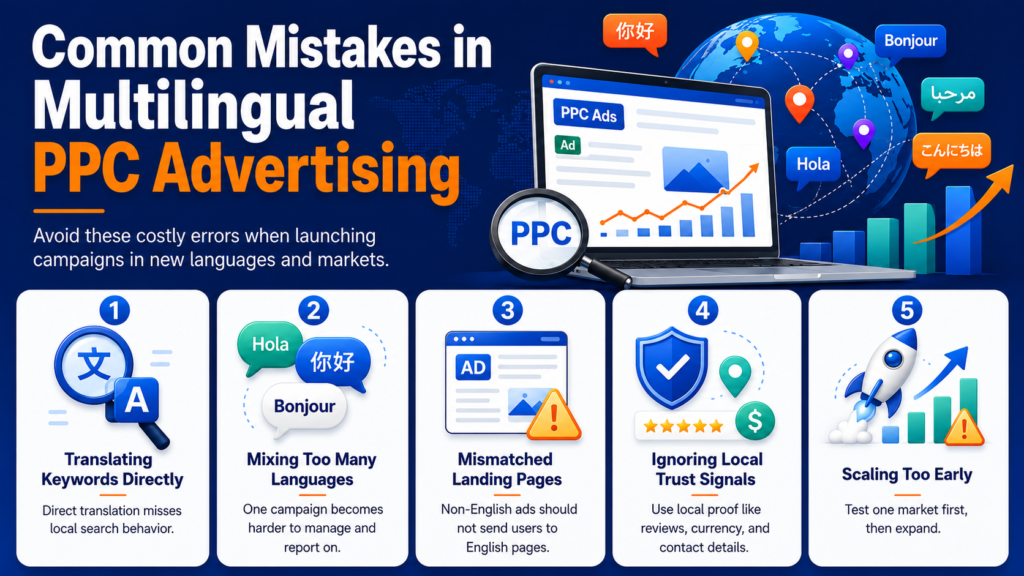
Common Mistakes in Multilingual PPC Advertising
Even experienced advertisers can waste budget when expanding into new languages. The most common mistakes are easy to understand but expensive to ignore.
When Should a Business Invest in Multilingual PPC?
Multilingual PPC advertising makes sense when at least one of these is true:
- You already get international website traffic.
- Your sales team receives leads from more than one language group.
- Your product or service can be delivered across regions.
- Competitors are already advertising in local languages.
- Organic search data shows multilingual demand.
- You have landing pages or sales support in the target language.
- Your current English campaigns are reaching a growth ceiling.
It is not a good fit if the business cannot serve customers in that language after the lead comes in. Advertising in French, Spanish, German, Arabic, or Mandarin creates an expectation. If your sales process cannot support that expectation, the campaign may generate leads but still fail commercially.
How to Start With a Smart International PPC Strategy
The safest approach is to start narrow.
Pick one target language and one priority market. Build a localized keyword set. Write ads for that audience. Send traffic to a matching landing page. Track the quality of every lead. Then use the data to decide whether to scale.
A good launch process looks like this:
- Choose the market based on business value, not only search volume.
- Build multilingual keyword research around local intent.
- Create language-specific ad copy.
- Localize the landing page and conversion path.
- Set campaign structure based on budget and reporting needs.
- Review search terms weekly in the first month.
- Measure qualified leads, not only form submissions.
- Expand only after one language proves performance.
For companies that need expert setup, optimization, and reporting, professional PPC Management Services can help avoid the common waste that happens when multilingual campaigns are built too quickly.
Final Thoughts
The biggest benefit of multilingual PPC advertising is not just reaching more people. It is reaching people with less friction.
When users search in their own language, see an ad in their own language, and land on a page that matches their expectations, the brand feels more relevant. That can improve trust, click-through rate, conversion rate, and market learning.
But multilingual PPC is not just translation. It is multilingual keyword research, audience segmentation, campaign structure, landing page localization, and language-level reporting working together.
For businesses planning serious growth beyond one market, multilingual PPC should be part of a wider Digital Marketing Strategy for Global Markets. Done properly, it helps companies test demand, reduce wasted spend, and build a stronger international growth engine.