

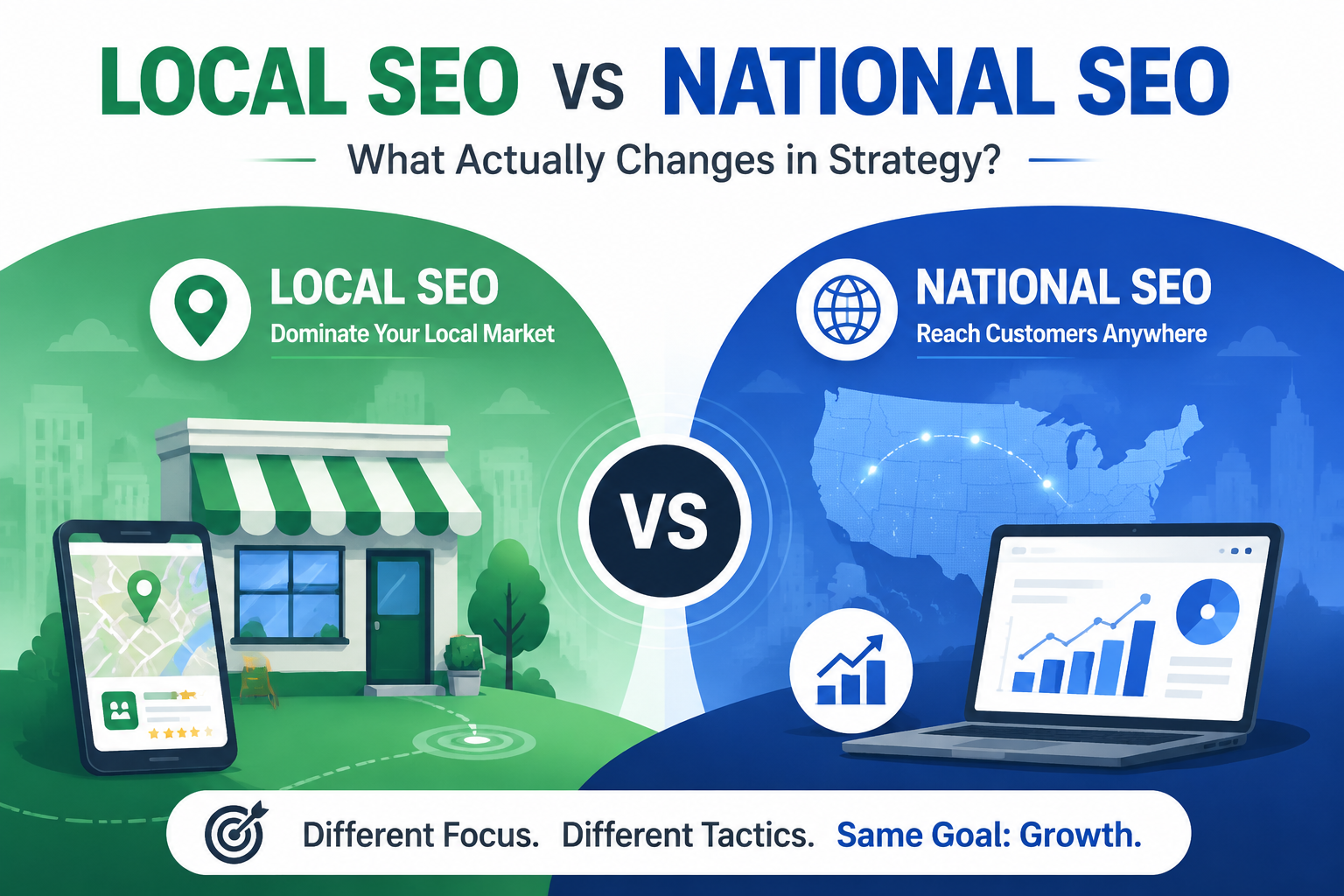
Many businesses misunderstand the difference between local SEO and national SEO. It is often reduced to geography, but that is an oversimplification.
The real distinction is how Google evaluates relevance, authority, and intent depending on search context.
A local business, a regional service provider, and a national brand all operate under different ranking systems, even if they target similar keywords.
Choosing the wrong strategy leads to wasted content, weak rankings, and poor ROI.
This guide explains what actually changes between local SEO and national SEO, and how to decide which approach fits your business.
What Is Local SEO?
National SEO targets users across a country or multiple regions without geographic limitation.
Examples of keywords include:
- project management software
- CRM platform
- accounting software
- cybersecurity services
- digital marketing agency
Here, Google does not rely on proximity. Instead, it evaluates:
- Domain authority
- Topical authority
- Content depth and structure
- Backlink quality
- Internal linking systems
- Brand strength
- User engagement signals
Competition is significantly higher because every brand competes in the same national SERP.
What Is National SEO?
National SEO targets users across a country or multiple regions without geographic limitation.
Examples of keywords include:
- project management software
- CRM platform
- accounting software
- cybersecurity services
- digital marketing agency
Here, Google does not rely on proximity. Instead, it evaluates:
- Domain authority
- Topical authority
- Content depth and structure
- Backlink quality
- Internal linking systems
- Brand strength
- User engagement signals
Competition is significantly higher because every brand competes in the same national SERP.
Local SEO vs National SEO: Core Strategy Differences
| Factor | Local SEO | National SEO |
|---|---|---|
| Target Area | City or region | Country or global |
| Main Objective | Local customer acquisition | Broad market visibility |
| Google Business Profile | Essential | Not required |
| Citations | High importance | Low importance |
| Content Style | Location focused | Topic focused |
| Backlinks | Local relevance | High authority domains |
| Reviews | Strong ranking factor | Minor influence |
| Competition | Regional businesses | National brands |
| Ranking Speed | Faster results | Slower growth |
| Strategy Focus | Geographic trust | Topical authority |
The key difference is simple.
Local SEO builds geographic trust.
National SEO builds topic authority.
Role of Google Business Profile in Local SEO
Google Business Profile is a core ranking asset for local businesses.
A strong profile includes:
- Accurate categories
- Service areas
- Updated business hours
- Photos and media
- Customer reviews
- Q&A section
- Regular posts and updates
For many local searches, users never visit the website. They call or navigate directly from Google results.
This makes GBP optimization a priority, not an optional task.
National businesses do not rely on GBP in the same way because visibility comes from organic rankings instead of maps.
Best for businesses that:
- Have a physical location or serve customers locally
- Rely on nearby customers for leads and sales
- Want to appear in Google Maps and Local Pack
- Depend on reviews and local reputation
- Compete with other businesses in the same city or region
Best for businesses that:
- Offer products or services that are location-independent
- Operate eCommerce stores or online platforms
- Target a broad audience across the country
- Want to build brand authority and topical expertise
- Compete with national or enterprise-level brands
Can You Use Both Strategies?
Yes, many businesses combine both approaches.
Example: A law firm might target:
Local keywords:
- personal injury lawyer Denver
- car accident attorney Boulder
National keywords:
- personal injury claim process
- workers compensation laws
- legal settlement guide
This hybrid model allows businesses to capture both local clients and broader informational traffic.
Common SEO Mistakes
Ignoring Google Business Profile
Missing or incomplete profiles reduce visibility in local search and Google Maps.
Targeting Keywords Too Early
Competing for high-volume national keywords without authority wastes resources.
Disconnected Content
Publishing random posts without a strategy prevents topical authority growth.
Duplicate Location Pages
Thin or duplicated pages confuse search engines and weaken rankings.
Low-Quality Backlinks
Irrelevant links reduce domain trust and can harm long-term performance.
Ignoring Reviews
Not managing reviews damages trust, conversions, and local rankings.
Focusing Only on Rankings
Traffic without conversions does not drive real business growth.
Weak Technical SEO
Slow pages, crawl issues, and poor mobile UX reduce visibility and indexing.
How to Choose the Right Strategy
Choose local SEO vs national SEO strategy based on how your customers search. If you rely on local SEO, meaning nearby customers, Google Maps visibility, and city-based searches, then focusing on local SEO strategy is the right choice for driving high-intent local traffic.
If your business targets users across regions or the entire country, then national SEO strategy is more effective, as it builds authority through content, backlinks, and broader keyword targeting. In many cases, combining both local SEO and national SEO strategy creates a stronger long-term growth model for scaling visibility beyond a single location.
Key Takeaways
Local SEO and national SEO are not just different targeting methods. They represent two fundamentally different systems of ranking signals.
Local SEO depends on:
- proximity
- reviews
- citations
- Google Business Profile
National SEO depends on:
- authority
- content depth
- backlinks
- topical relevance
The right strategy depends on how customers search for your service, not just where they are located.