

Do you also notice wrong information sometimes appearing in AI search answers?
AI-generated responses now appear at the top of search results. Even though they look confident, these summaries can still contain mistakes or outdated information.
For many people, this means getting instant answers without having to click through multiple websites. But speed and confidence don’t always equal accuracy. In some cases, AI summaries oversimplify complex topics, pull outdated data, or misinterpret sources. Understanding when to trust AI search and when to double-check has become an essential digital skill.
Why AI Search Feels So Trustworthy
AI summaries are designed to be helpful and easy to read. They combine information from multiple sources into one clear response, which saves time and reduces information overload.
Several psychological factors make these answers feel reliable, and understanding AI search optimization can help users navigate the results more effectively.
- Clarity creates confidence — concise summaries feel authoritative.
- Speed builds trust — fast answers reduce doubt.
- Authority bias — information shown at the top feels official.
- Reduced effort — users are less likely to question convenient answers.
Because of this, many users stop clicking sources entirely, even when the topic requires deeper verification.
When AI Overviews Can Be Misleading
AI search results are improving, but they are not perfect. Problems may occur when:
- Information is outdated
- Complex topics are oversimplified
- Statistics lack context
- Conflicting sources are merged incorrectly
- Niche or emerging topics lack reliable data
This doesn’t mean AI answers are intentionally misleading, but they can sometimes be incomplete or inaccurate.
Real Situations Where Mistakes Matter
Small inaccuracies may seem harmless, but in certain situations, errors can have serious consequences.
- Health decisions
Misinterpreted symptoms or treatment advice can delay proper care. - Financial choices
Incorrect tax rules or investment details can lead to costly mistakes. - Travel & visa requirements
Outdated entry rules can disrupt travel plans. - Legal information
Laws vary by region, and simplified summaries may omit critical details. - Product safety & usage
Incorrect instructions can pose safety risks.
When the stakes are high, relying on a single AI summary is not enough.
Why AI Gets Things Wrong
AI search tools do not “know” facts the way humans do. They predict responses based on patterns in data.
Errors can occur because:
- Information online may conflict
- Data may be outdated
- Context can be misunderstood
- Models may generate plausible but incorrect statements (“hallucinations”)
Think of AI as a smart assistant, not an infallible authority.
How to Verify AI Answers in 30 Seconds
A quick check can prevent costly mistakes.
✔ Click the source links
Confirm the information comes from reputable websites.
✔ Check the date
Outdated information is a common issue.
✔ Cross-check with two reliable sources
Look for consistency.
✔ Prioritize expert organizations
Government, academic, and professional bodies are more reliable.
✔ Avoid relying on summaries alone
Especially for health, legal, or financial topics.
For businesses looking to leverage AI responsibly, Noah Digital can help you create tailored strategies that prioritize accuracy and efficiency.
What Users Are Saying About AI Search Accuracy
In a Reddit discussion, users warn that Google’s AI summaries can sound confident while presenting incomplete or misleading information. Because these answers appear at the top of search results, they often feel authoritative, discouraging users from checking sources. The discussion reflects a growing awareness that AI search should be used as a starting point, not the final answer.
Smart Habits for Safer AI Search
Building simple habits can help you avoid misinformation:
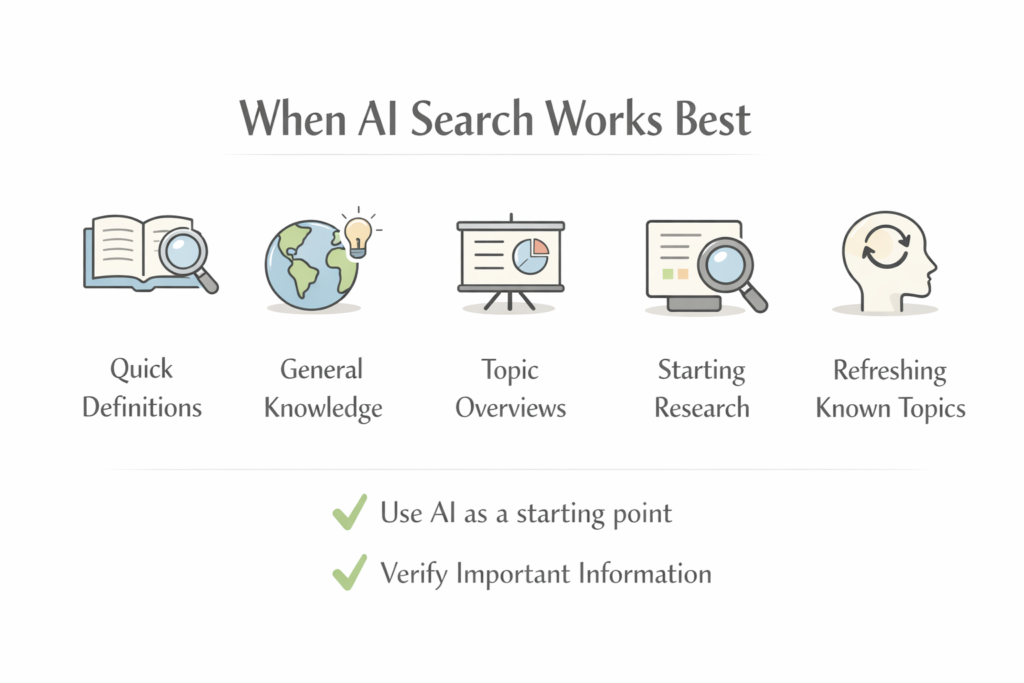
- Treat AI as a research assistant, not the final authority.
- Verify important information before acting on it.
- Check primary sources for critical decisions.
- Be cautious when sharing AI-generated information.
- Look for consensus across trusted sources.
Digital literacy now includes knowing how to question automated answers.
The Future of AI Search and Digital Literacy
AI search will continue to improve, but no technology replaces critical thinking. As AI becomes more integrated into daily life, the ability to verify information quickly will be just as important as finding it.
The goal isn’t to distrust AI, it’s to use it wisely.
By combining AI efficiency with human judgment, users can stay informed, avoid misinformation, and make better decisions in an increasingly automated world.