

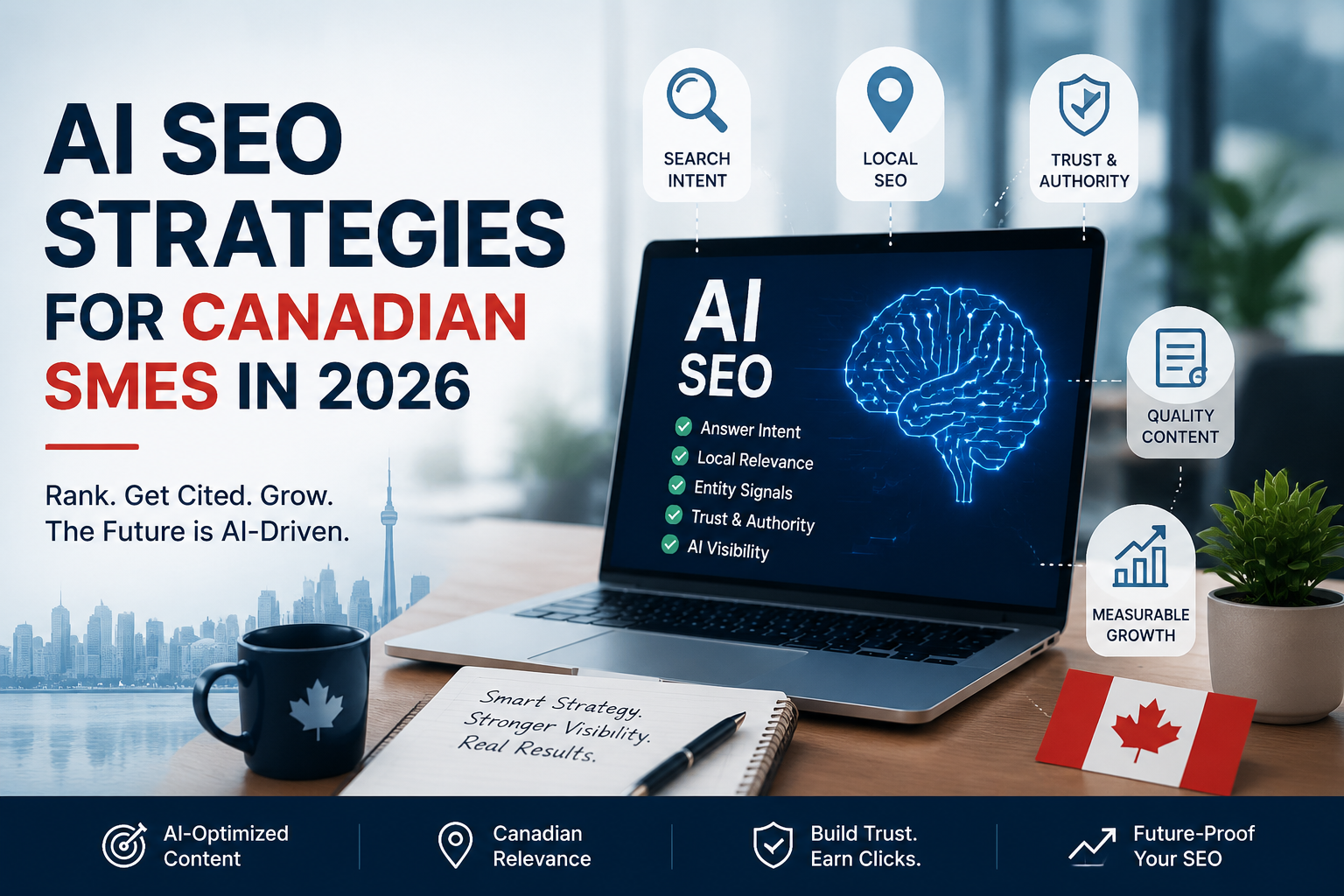
AI SEO in 2026 is not about writing content just for ChatGPT and hoping your business gets mentioned. For Canadian SMEs, the focus should be on making your website, services, reviews, and expertise clear and trustworthy so search engines and AI tools can easily understand and recommend your business.
AI use among Canadian SMEs is growing quickly. Statistics Canada reported AI adoption increased from 6.1% in Q2 2024 to 12.2% in Q2 2025, while the BDC found that 30% of SMEs were using AI in 2025. Businesses that create helpful, locally relevant content now have a better chance of competing with larger companies online.
Strategy 1: Build Answer-First Pages
AI systems are designed to answer questions. Your pages should do the same.
Focus on answering:
- What your company offers and who it’s for
- Where your services are available
- The problem you solve and why you’re credible
- What action users should take next
Start headings with answers, not fluff. Removing filler and answering the heading immediately helps AI understand your content.
Strategy 2: Treat Local SEO as an AI Asset
Local SEO is still a major source of high-intent leads. For AI SEO, core trust signals matter:
- Accurate NAP (name, address, phone)
- Google Business Profile with reviews and photos
- Service pages with local relevance
- Embedded map where relevant
- LocalBusiness schema
Local SEO isn’t just “near me” optimization. It helps AI systems understand and trust your business as a local entity.
Strategy 3: Build Entity Proof, Not Just Content
AI systems prioritize trustworthy evidence over sheer volume.
Instead of 100 generic blog posts, focus on proof-heavy pages:
- “How We Helped a Vancouver Retailer Reduce Monthly Bookkeeping Errors”
- “Our Process for CRA-Ready Small Business Accounting”
- “Meet the Team Behind [Brand Name]”
- “Small Business Accounting Services in Vancouver”
These pages give AI systems concrete facts to cite, boosting your visibility.
Strategy 4: Create Bottom-Funnel AI Search Content
Broad blog posts like “Why SEO Is Important” are easy for AI to summarize without sending traffic.
Prioritize decision-stage content in 2026:
- Best [service] in [city]
- [Service] cost in Canada
- [Service] vs [alternative]
- How to choose a [provider] in [province]
- Questions to ask before hiring a [service provider]
- [Industry] compliance guide
- Local case studies
- Pricing explainers
- Comparison pages
Users search with real intent:
“Best bookkeeping service for a small business in Calgary”
“How much does commercial cleaning cost in Toronto?”
This type of content has real business impact.
Strategy 5: Use Reddit & UGC to Understand Buyer Language
Reddit isn’t a scientific dataset, but it’s great for uncovering how people talk about challenges and solutions.
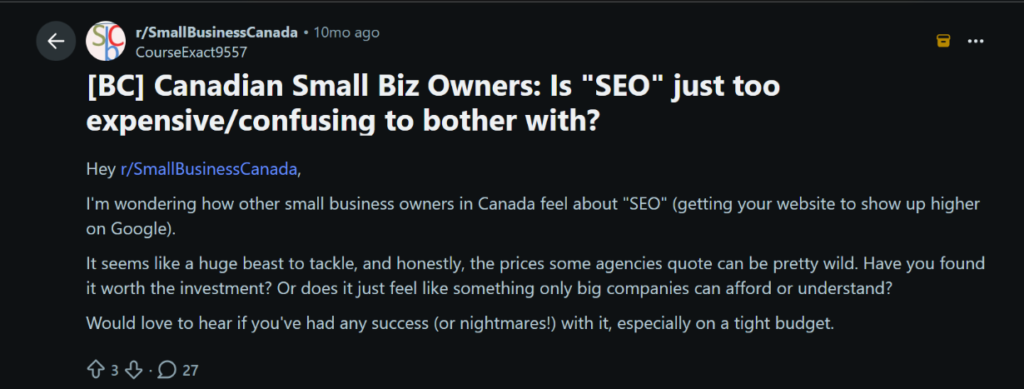
Canadian SMEs can turn these insights into content like:
- “Is SEO Worth It for Canadian Small Businesses in 2026?”
- “How Much Should a Small Business Spend on SEO in Canada?”
- “What Can You Do Yourself Before Hiring an SEO Agency?”
- “SEO vs Google Ads for Canadian Small Businesses”
Focus on useful visibility, not just raw metrics.
Conclusion: Trust Still Wins
For Canadian SMEs, AI SEO in 2026 is not about tricks. It is about making your business easier to understand, verify, cite, and choose.
The strongest strategy combines:
- Publish answer-first content
- Provide local proof and entity signals
- Use structured data
- Reflect real customer language
Weak AI SEO publishes more content and hopes it ranks. Strong AI SEO becomes the clearest, most trusted answer to the questions Canadian buyers are asking.
Audit your website today, ensure every page answers key questions, reflects local trust, and provides real proof your audience can trust.