

SEO ranking factors are always changing, which makes it difficult for businesses to know what deserves attention. Still, the goal of SEO has not changed: your website needs to be easy for search engines to crawl, understand, trust, and show to the right users.
A well-optimized website can keep attracting traffic long after a page is published. More visibility in organic search can lead to more qualified visitors, more leads, and more sales. Without strong SEO ranking, searchers may never find your website, even if your products or services are exactly what they need.
In this guide, we will cover the most important SEO ranking factors you need to know if you want to improve Google rankings, strengthen organic search performance, and give users a better experience on your site.
What Is Ranking in SEO?
In SEO, ranking refers to the position of your content on search engine results pages, also called SERPs. A number one ranking means your page appears as the first organic result when users search for a specific keyword or phrase.
Ranking in the top three results is valuable because click-through rates usually increase the closer a page gets to the top position. Appearing on the first page is also important, since the original article notes that 95% of users never go beyond the first page.
Top 10 Current SEO Ranking Factors for Google
Google processes more than 67,000 searches per second and accounts for over 79% of global desktop and mobile traffic, according to the figures cited in the original article. This is why visibility on the first page matters. The same article also notes that 75% of internet users never scroll past the first page.
Ranking well may sound simple, but many search engine ranking factors affect whether a page performs well in SERPs. Google applies hundreds of signals to evaluate websites. Below are 10 important SEO ranking factors that can help move your website closer to the top of organic search results.
When these factors are analyzed and applied correctly, your website can rank higher while also improving the experience for visitors. That can support lead generation and contribute to an exponential increase in your sales and revenue.
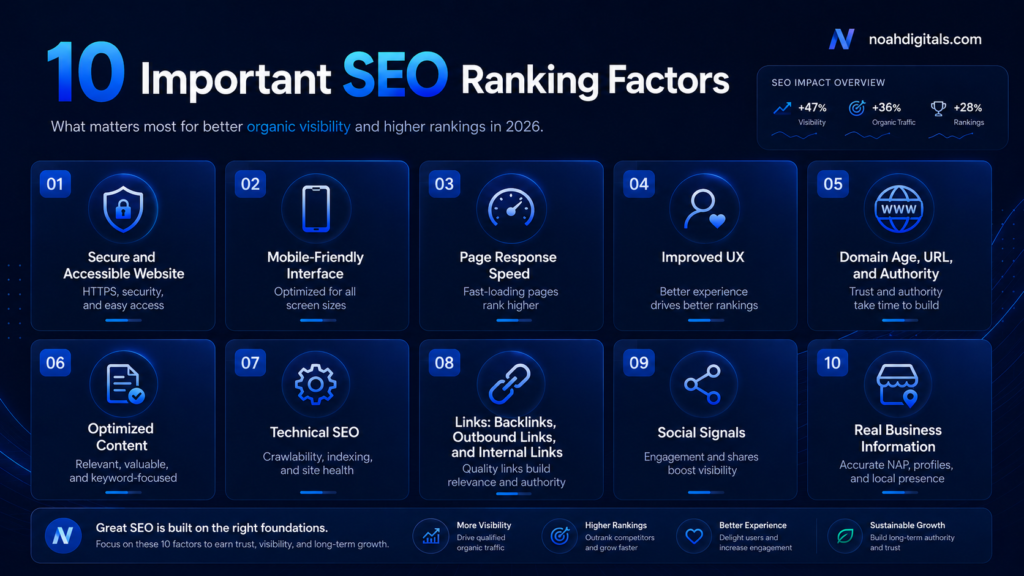
1. A Secure and Accessible Website
One of the most important SEO ranking factors is having a website that search engines can access and crawl. Google needs to visit your pages, read your content, and understand how your site is structured.
To make your website crawler-friendly, you need the following elements:
- A website built on a well-coded platform
- A robots.txt file that guides Google on where it can find your content
- A sitemap that lists your site pages
HTTPS is not the only requirement for indexing, but it is still useful. Google has described HTTPS as a light-weight ranking factor, and it also supports user trust. At Noah Digital, we agree that HTTPS is beneficial because security and user experience work together.
Security also includes lead quality and site protection. You should get rid of spam leads so that your website traffic and form submissions stay relevant and valuable. Spam leads can affect engagement quality and waste time for your sales team. CAPTCHA, form validation, and other protective steps can help reduce spammy activity.
You should also have a plan for what to do if your site is hacked. A compromised website can damage SEO rankings, user trust, and online reputation. Regular updates, malware scanning, strong passwords, and an emergency recovery plan can help protect your site and users.
2. Mobile-Friendly Interface
A mobile-friendly website is no longer optional. The original article notes that 50% of consumers prefer businesses with a mobile-friendly website. Since more users browse on mobile devices, Google also prioritizes mobile-optimized pages through mobile-first indexing.
If your website works well on desktop but creates friction on mobile, you can lose rankings and visitors. A strong mobile experience should include:
- Responsive design that adjusts to any device
- Large, readable fonts for smaller screens
- Clear menus that make navigation simple
- Ads that do not block important content
If you have the resources, AMP can be considered for faster mobile loading. However, AMP requires a separate version of the site and ongoing maintenance. Whether you use AMP or not, the priority should remain the same: make your website fast, readable, and easy to use on mobile devices.
3. Page Response Speed
Page speed became a ranking factor for mobile searches in July 2018. It is also a practical business issue because slow pages frustrate visitors and can reduce conversions.
Page response speed refers to how quickly your website loads and reacts when someone visits. Large, uncompressed images, heavy scripts, and complex media can slow down a page. The original article notes that 8.6 seconds is the international average and that 40% of visitors leave within 3 seconds if a website does not load.
This is why speed optimization should be treated as both a technical SEO task and a user experience task. A faster website can keep visitors engaged, reduce abandonment, and support stronger search engine rankings.
4. Improved UX
User experience is closely connected to SEO ranking. Google uses signals such as RankBrain to better understand how people interact with search results and web pages.
Important user behavior signals include:
- Click-through rate: the percentage of users who click your page after seeing it in search results
- Bounce rate and pogo-sticking: users leaving quickly and returning to search results
- Dwell time: how long visitors stay on your page after clicking through
If users visit your page and leave almost immediately, Google may read that as a sign that the page does not match their needs. If this happens often, ranking higher becomes harder.
This is why your content must match search intent. Titles, descriptions, page copy, navigation, and layout should all help visitors find what they expected when they clicked.
SEO and PPC integration for maximum results can also support better user engagement across organic and paid channels. When messaging is consistent, users are more likely to understand the offer, stay on the page, and move toward conversion.
5. Domain Age, URL, and Authority
Domain age can influence SEO performance. The original article cites an Ahrefs study showing that almost 60% of websites in the top 10 Google search results are at least three years old, while fewer than 1-year-old sites reach those positions.
If your website has been online for a while and you have already worked on SEO, you may have an advantage. However, age alone is not enough. The site still needs useful content, strong technical foundations, and authority signals.
The domain name can also matter in some cases. Google tends to penalize spammy exact-match domains with low-quality content. At the same time, the original article notes that relevant, valuable, and high-quality exact-match domains may still receive a ranking boost. If your website is already established, there is no need to chase an exact-match domain. Choose a URL that accurately reflects your business and optimize the website properly.
Authority is another key part of SEO. It usually combines high-quality content with off-page signals such as inbound links and social shares. The authority of the content creator can also support trust.
To strengthen website authority, businesses can use digital marketing trends as part of a broader strategy for visibility, reputation, and organic growth.
Tools such as Moz use page authority and domain authority scores from 0 to 100 to estimate how likely a page or domain is to rank in organic search results. These metrics can help you assess authority, established links, and new links.
6. Optimized Content
Optimized content is one of the strongest SEO ranking factors because it helps search engines understand what a page is about and helps users find useful answers.
Keywords still matter. They are the words and phrases users search for, and they also describe the topic of your page. Relevant keywords should appear naturally in headings, opening paragraphs, body copy, metadata, image alt text, and supporting sections. The goal is not keyword stuffing. The goal is clarity.
Duplicate content can weaken SEO performance, so fresh and original material is important. If similar content exists, canonical URLs can help identify the most authoritative version. To align content with a modern digital marketing strategy for your business, focus on rich, optimized content that serves both search engines and readers.
Understanding LSI Keywords and SEO Ranking
SEO optimization goes beyond one main keyword. Related terms help search engines understand the context of your content. For example, related wording can clarify whether “mini” refers to a car or a skirt. This context can improve relevance and help the page match the right searches.
Answer Boxes and the Zero Position
Optimizing for answer boxes can improve visibility in search results. To increase the chance of being selected, your content should:
- Answer questions clearly
- Use headings with proper title tags
- Keep answers concise and relevant
- Target keywords that already show answer boxes
The zero position can sometimes reduce click-through rates because users may get the answer directly in search results. However, it can still improve brand recognition and overall visibility.
Using Video to Improve SEO Ranking
Video content can support engagement, sharing, and link-building. The original article notes that 79% of people prefer watching a video over reading text. Adding useful videos can keep visitors engaged and provide additional value, which can support SEO performance over time.
7. Technical SEO
Technical SEO helps search engines crawl, understand, and display your website correctly. It may sound complex, but many important technical elements can be improved without advanced coding knowledge.
Key technical SEO areas include:
- Page titles: Include keyword phrases in page titles because this is one of the first places Google checks for relevance.
- Header tags: Use headings to create a clear content hierarchy, with the main title as H1 and subheadings as H2 or H3.
- Meta descriptions: Write concise, compelling descriptions that include keyword phrases and encourage clicks. About 160 characters is a useful target.
- Image alt tags: Add descriptive alt text that improves relevance and accessibility for users with screen readers.
- Schema markup: Use structured data to help Google understand the type of content on your site.
An on-page SEO checklist can make this work easier. Helpful SEO features can include metadata tools, schema markup, XML sitemaps, a robots.txt editor, SEO health checks, and other site optimization tools.
8. Links: Backlinks, Outbound Links, and Internal Links
Links are a core part of the web and remain an important SEO ranking signal. The three main types of links are inbound links, outbound links, and internal links. All three should use descriptive anchor text that clearly explains where the link leads.
Inbound Links
Inbound links, also called backlinks, help Google evaluate the authority and relevance of your content. A backlink from a trusted, authoritative website is usually more valuable than a link from a low-quality site. The goal is to earn links from relevant, high-authority domains while reducing the risk of low-quality backlinks.
Outbound Links
Outbound links connect your content to relevant, authoritative sources in your niche. These links can add value for users when they support claims or guide readers to helpful references. However, adding too many outbound links only for authority can weaken the reading experience. The priority should always be usefulness and relevance.
Internal Links
Internal links connect pages on your own website. They help users move through your content and help search engines understand the relationship between pages. When an authoritative page on your site links to another relevant page, it can help that linked page gain visibility.
As you publish new content, build a clear internal linking structure. Use descriptive anchor text so both users and search engines understand the context of each link.
9. Social Signals
When users share your content on social networks, it shows that people find the content useful or interesting. The original article cites a CognitiveSEO study of 23 million shares that found a clear correlation between social shares and search engine rankings.
Google has said that social shares are not a direct SEO ranking factor and that links from social platforms are not weighted like links from authoritative websites. Still, pages with strong rankings often have many shares. This can happen because social sharing can drive more traffic and increase the chance of earning backlinks.
Social signals may not directly cause higher rankings, but they can indirectly support SEO. To make the most of this, build a strong social media presence and make it easy for users to share your content.
10. Real Business Information
Accurate business information is especially important for companies that serve specific local areas. For local SEO, search engines need to understand who you are, where you are, and how customers can contact you.
Important local SEO elements include:
- NAP consistency: Make sure your name, address, and phone number are consistent across all platforms.
- Business listings: Keep listings on Google Business Profile and Facebook updated.
- Reviews: Manage and encourage reviews on important platforms and relevant directories such as Yelp.
- Local search terms: Use appropriate local keywords to improve visibility for nearby searchers.
When your website and business listings show clear, consistent information, search engines can understand your local relevance more easily. This can improve local SEO performance and help nearby customers find your business.
Conclusion
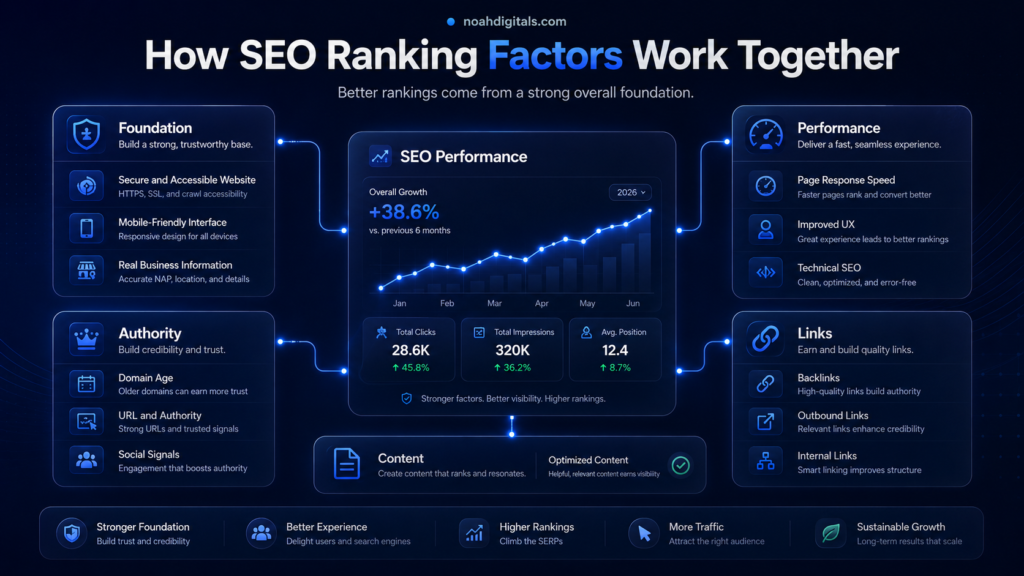
SEO ranking factors may change, but the foundation remains consistent. Your website needs to be accessible, secure, mobile-friendly, fast, useful, technically clean, and supported by strong content and links.
By focusing on website accessibility, mobile optimization, page speed, user experience, high-quality content, technical SEO, backlinks, internal links, social signals, and real business information, you can improve both search engine rankings and the experience visitors have on your site.
At Noah Digital, we understand how SEO ranking factors work together and how they affect business growth. Our team helps businesses improve visibility, attract qualified visitors, and create stronger organic search performance through our search engine optimization services.